📞 88558 10010 Silver Leaf Clinic 📞 +91 20 6768 9704 Landline 📞 84118 08284 Dr. Gore / WhatsApp
Silver Leaf Clinic · Hadapsar, Pune · Colorectal & GI Cancer Centre
Home Procedures Stoma Care & Reversal
Colostomy · Ileostomy · Planned Reversal

Stoma Care & Reversal

A Complete Guide for Patients & Families · Pune

A stoma can feel frightening when you first hear the word — but with the right preparation and care, the vast majority of people return to a full, normal life: working, travelling, exercising and eating well. And in colorectal cancer surgery, many stomas are temporary. This guide explains everything: what a stoma is, how to care for it day to day, how to solve common problems, and how reversal works.

Pre-op Stoma Siting Colostomy & Ileostomy Daily Care & Diet Planned Reversal
Rectal Cancer Surgery - Dr. Vinod T. Gore
Understanding a Stoma

What is a stoma?

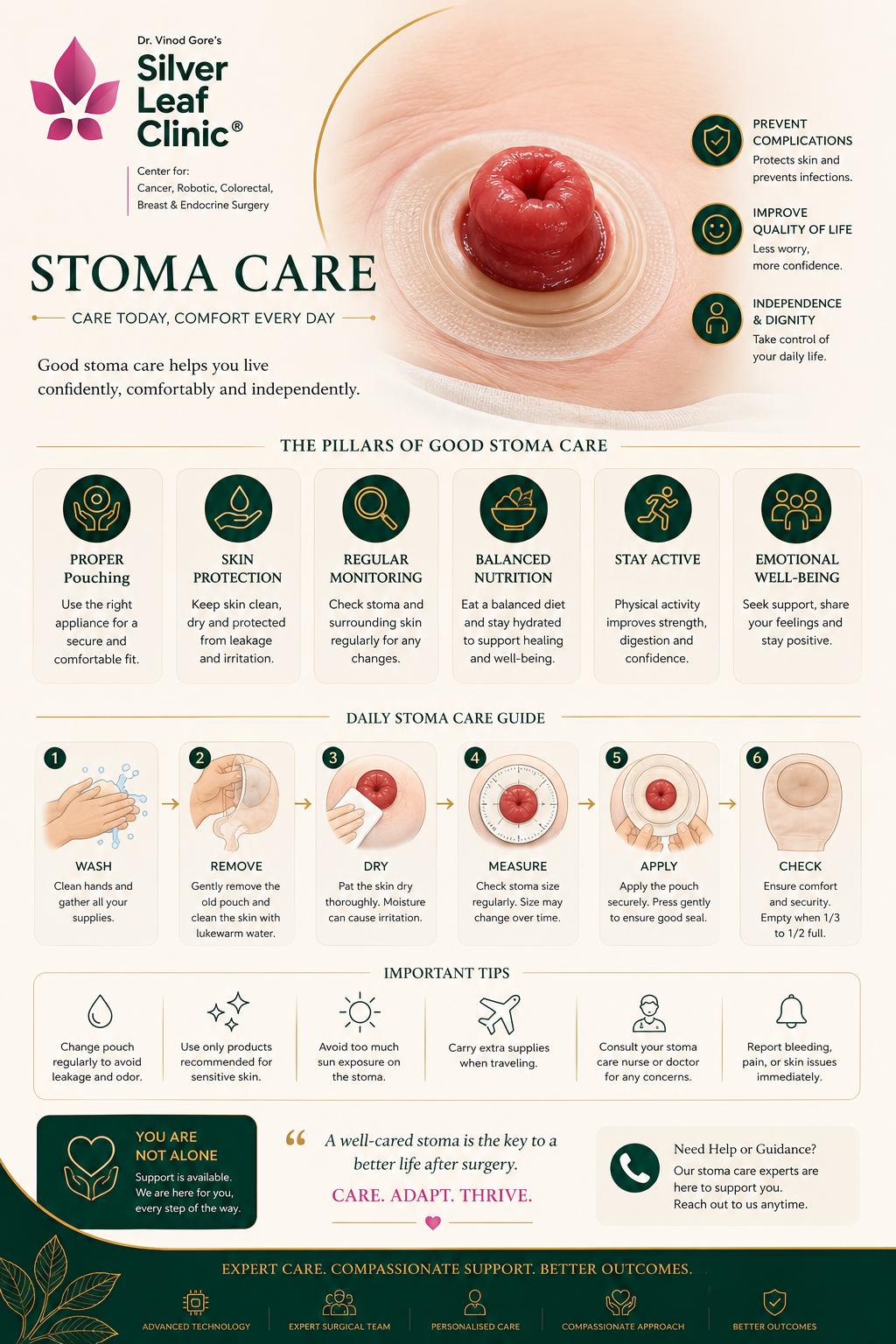
A stoma is an opening made on the surface of the abdomen that allows waste to leave the body into a pouch (bag), instead of passing the usual way through the back passage. The surgeon brings a small part of the bowel to the skin and turns it back like a cuff, creating a soft, pink, moist opening — a little like the inside of your cheek.

A stoma has no nerve endings, so it is not painful to touch. It has no muscle to control it, which is why a pouch is worn to collect waste. The pouch is discreet, odour-proof when closed, and sits flat under clothing — most people you meet would never know it is there.

In colorectal cancer surgery, a stoma is created for one of two reasons: to protect a new join in the bowel while it heals (a temporary stoma), or because the back passage and rectum have had to be removed (a permanent stoma). Whether yours is temporary or permanent is something Dr. Gore will tell you clearly before your operation.

The single most important message: a stoma is a means to an end — it lets us remove the cancer safely and let the bowel heal. For a large number of patients, it is a temporary step on the way back to normal.

You are not alone — and you will be taught
Every patient who has a stoma is supported by a trained stoma care nurse who teaches you (and a family member) exactly how to manage it, step by step, before you go home. Learning to care for a stoma takes most people only a few days. What feels impossible at first becomes a quick daily routine within weeks.
Types of Stoma

Colostomy, ileostomy — and what the difference means

The type of stoma depends on which part of the bowel is used and why. This affects what the output looks like and how you care for it.

Colostomy
Made from the colon (large bowel), usually on the left side. Output is firmer and less frequent, closer to formed stool. Often used after surgery for rectal or left-sided colon cancer.
Ileostomy
Made from the ileum (small bowel), usually on the right side and slightly spouted. Output is looser and more frequent, and contains enzymes — so skin protection matters more. Commonly used to protect a rectal join.
Loop stoma (temporary)
A loop of bowel brought to the surface with both ends opening through one stoma. Easiest to reverse — most "protective" stomas after rectal surgery are loop ileostomies, designed from the start to be closed later.
End stoma
A single cut end of bowel brought to the surface. May be temporary (Hartmann's) or permanent (after removal of the rectum and anus in an APR).
Temporary stoma
Created to rest a healing join, then reversed — often after 8–12 weeks (longer if chemotherapy is needed in between). Planned for closure from the outset.
Permanent stoma
Needed when the anal sphincter or rectum cannot be preserved. With modern sphincter-preserving surgery, this is needed far less often than in the past — but when it is, life with it is genuinely full.
Before Surgery

Why a stoma is needed — and the vital step of siting

If there is any chance you will need a stoma, the position is marked on your abdomen before the operation. This single step — stoma siting — is one of the biggest predictors of how easy life with a stoma will be.

Why
To protect a healing join
After low rectal surgery, a temporary stoma diverts stool away from the new join, dramatically reducing the danger of a leak while it heals.
Why
When the rectum must be removed
If cancer involves the anal sphincter (very low rectal or anal cancer), a permanent stoma is created after removing the back passage.
Why
In emergencies or obstruction
If the bowel is blocked or perforated, a stoma may be the safest immediate step, with reversal considered later.
Siting
Marked by the stoma nurse before surgery
You are assessed sitting, standing and lying. The site avoids your waistline, belt, skin creases, scars and bony points — so the pouch sits flat and seals reliably.
Siting
Why a good site changes everything
A well-sited stoma is easy to see, easy to reach, and leak-free. A poorly sited one causes endless leaks and skin problems. We never skip this step when it can be planned.
Daily Care · For Patients & Caregivers

Looking after your stoma, step by step

This is the practical heart of stoma care. It looks like a lot at first — but within a couple of weeks it becomes a fast, private routine you barely think about.

Rectal Cancer Surgery - Dr. Vinod T. Gore
Emptying
Emptying the pouch
Empty a drainable pouch when it is about one-third full — usually a few times a day. Sit on the toilet, open the end, empty, clean the opening and re-close. It takes a minute, and is done sitting down in private.
Changing
Changing the pouch / baseplate
The whole appliance is changed every 1–3 days (or as advised). Gently peel the baseplate off the skin downwards, supporting the skin — never tug. Have your new pouch cut and ready first.
Skin
Cleaning & protecting the skin
Clean around the stoma with warm water and a soft cloth only — no soap, wipes or creams unless advised, as they stop the pouch sticking. Pat fully dry. Healthy skin should look like the skin elsewhere — not red or sore.
Fit
Getting the right fit
The hole in the baseplate should match your stoma exactly — too big exposes skin to output, too small rubs the stoma. The stoma shrinks over the first weeks, so re-measure regularly and recut.
Supplies
Keeping a kit ready
Carry a small kit: spare pouches, scissors, disposal bags, dry wipes and a change of underwear. Keep one in your bag and one in the car, so you are never caught out.
Diet & Fluids

Eating well with a stoma

Most people return to a normal, varied diet. In the first 6–8 weeks the bowel is settling, so a few simple principles help — especially with an ileostomy.

Early weeks
Start low-fibre, then widen
For the first weeks, lower-fibre foods reduce blockage risk while the bowel settles. Reintroduce fibre, fruit and vegetables gradually, one new food at a time.
Chew well
Chew thoroughly, eat regularly
Well-chewed food passes easily. Regular meals give a more predictable output than skipping and overeating. Eating less in the evening reduces overnight output.
Ileostomy
Watch hydration & salt
An ileostomy loses more fluid and salt, so drink enough and don't under-salt food. Signs of dehydration — thirst, dark urine, cramps, tiredness — mean you need more fluids and salt, and advice if it persists.
Foods to know
Foods that can block, loosen or cause gas
Stringy/fibrous foods (nuts, sweetcorn, mushrooms, skins) can block an ileostomy if not chewed well. Spicy or sugary foods can loosen output. Fizzy drinks, beans and onions add gas — manageable, not forbidden.
A simple rule for ileostomy blockages
If output stops and you have cramps and a swollen tummy, stop eating solids, sip warm fluids, try a warm bath and gentle knee-to-chest movement. If it doesn't settle in a few hours, or you start vomiting, contact us or go to hospital — a blockage needs prompt attention, not waiting.
Troubleshooting

Common problems — and what to do

Almost every stoma problem has a simple solution. Use this as a quick reference — and remember your stoma nurse is only a phone call away.

Stoma problems & troubleshooting guide
ProblemWhy it happensWhat to doCall for help if…
Sore, red skin Output leaking onto skin; baseplate hole too big; frequent changes Re-measure and recut to fit exactly; ensure skin is dry before applying; use barrier products as advised Skin is broken, weeping or spreading
Leaks under the pouch Poor fit, skin creases, sweating, or stoma in a dip Check the fit; try a convex baseplate or seal/paste; change before it's too full Leaks keep recurring despite refitting
Ballooning (gas filling bag) Trapped wind, certain foods, fizzy drinks Use a pouch with a filter; release gas; adjust gas-forming foods Persistent and distressing
Blockage (ileostomy) Fibrous food not chewed; narrowing Stop solids, sip warm fluids, warm bath, knee-to-chest position No output for hours, cramps, vomiting
High/watery output New ileostomy, infection, some foods/medicines Rehydrate with salt-containing fluids; thicken diet; review medicines Dehydration signs, output stays very high
Stoma bleeding (slight) Stoma is delicate; cleaning can graze it Light oozing on cleaning is normal; apply gentle pressure Bleeding from inside the stoma, or heavy
Stoma colour change Should be pink/red & moist; dusky = poor blood supply Note any change; keep it moist Dark, purple or black stoma — urgent
Bulge around stoma (hernia) Weakness in the abdominal wall over time Support garment as advised; avoid heavy lifting; many are managed without surgery Painful, hard, or output stops
Stoma retracting or prolapsing Stoma sinks in, or telescopes out further Convex pouch for retraction; lie down and apply cool cloth for prolapse Prolapse darkens, or care becomes impossible

Red-flag signs that need prompt contact: a stoma that turns dark/purple/black, no output for several hours with cramps and vomiting (blockage), signs of dehydration, or skin that is broken and spreading. When in doubt, call — it is always better to ask early.

Living Your Life

A stoma doesn't have to stop anything

This is the part patients most want to hear, and it is true: people with stomas work, travel, swim, exercise, have relationships and raise families. Here's how.

Work
Most people return to work within weeks. The pouch is invisible under clothing. You're entitled to discretion and to use accessible toilets.
Travel
Carry double supplies in hand luggage, keep a travel certificate, and stay hydrated. People with stomas travel the world.
Swimming & exercise
You can swim — the pouch is waterproof. Walking and gentle exercise help recovery; build up gradually and avoid heavy lifting early to prevent hernia.
Clothing
Normal clothes work. Some prefer higher-waist styles or support underwear. No special wardrobe needed.
Relationships & intimacy
Intimacy is absolutely possible. Smaller pouches and wraps help confidence. Honest conversation and time make the difference.
Emotional wellbeing
Feeling low or anxious at first is normal and usually eases. Stoma support groups and your nurse help enormously — you are far from alone.
Stoma Reversal

Closing a temporary stoma — getting back to normal

If your stoma was created to protect a healing join, the goal from day one is to reverse it. Here is how that works, and what to expect.

Who
Who can have a reversal
Reversal is for temporary (usually loop) stomas, once the join below has fully healed, any chemotherapy is complete, and you are well enough. A scan or scope checks the join is intact and watertight first.
When
Timing
Often around 8–12 weeks after the first operation — but later if you need chemotherapy in between, which takes priority. There is no harm in a sensible wait; healing and cancer treatment come first.
Operation
What the surgery involves
Usually a smaller operation through the incision around the stoma. The bowel ends are rejoined and returned inside, and the opening is closed. A hospital stay of a few days is typical.
Recovery
Recovery & first weeks
The bowel takes time to wake up, so expect frequent, loose or urgent motions at first. This is normal and improves over weeks to months as the bowel adapts.
Check join first (scan/scope) Chemo completed Smaller operation Few days in hospital Gradual bowel recovery
After Reversal · Bowel Function

Understanding LARS — bowel changes after reversal

After a low rectal join is reversed, many people notice their bowel habit is different from before. This is called Low Anterior Resection Syndrome (LARS). Knowing about it in advance makes it far less distressing — and there is a great deal we can do to help.

What
What LARS feels like
A mix of some of these: frequent motions, urgency, going several times close together (clustering), difficulty fully emptying, and variable control of wind or stool. It happens because the rectum's reservoir function is reduced after surgery.
Course
It usually improves with time
LARS is often most noticeable in the first months and improves over the first 1–2 years as the bowel adapts. Most people settle into a manageable, predictable pattern.
Manage
Diet & routine
Identifying trigger foods, regular meal times, and a consistent routine all help. A food-and-symptom diary is genuinely useful in the early months.
Manage
Medication & bowel retraining
Simple measures — bulking or anti-diarrhoeal medicines, and timed toileting — make a big difference. We tailor these to your pattern.
Manage
Pelvic floor & specialist support
Pelvic floor exercises and physiotherapy strengthen control. For persistent symptoms, options such as transanal irrigation or nerve stimulation can help, guided by the team.
Support
You will not be left to cope alone
LARS is recognised and treatable. We review your bowel function at follow-up and adjust the plan — it is a normal part of recovery we manage together.

For more on preserving bowel function and avoiding a permanent stoma, see our Sphincter Preservation page.

Patient Questions

Stoma care & reversal — answered plainly

No. Modern pouches are flat, discreet and odour-proof when closed, and sit hidden under normal clothing. People around you will not know unless you choose to tell them. Most patients are surprised at how invisible it is.
That depends on your operation, and Dr. Gore will tell you clearly before surgery. Stomas made to protect a healing join are temporary and planned for reversal, usually after a few months. A permanent stoma is only needed when the anal sphincter or rectum has to be removed — which modern sphincter-preserving surgery avoids far more often than before.
No. The stoma itself has no nerve endings, so touching and cleaning it is not painful. The surrounding skin can become sore if output leaks onto it, but that is preventable with a well-fitting pouch — which is exactly what your stoma nurse teaches you.
Most people manage their stoma confidently within a couple of weeks and return to work, driving and social life over the following weeks. Avoid heavy lifting for a few weeks to protect against a hernia, then build activity back up gradually.
Usually around 8–12 weeks after the first operation, once the join has healed and any chemotherapy is complete. We confirm the join is intact with a scan or scope before reversal. If chemotherapy is needed, that takes priority and reversal waits — a sensible delay does no harm.
At first, expect frequent, loose or urgent motions — this is normal as the bowel wakes up. Many people who had low rectal surgery experience LARS (Low Anterior Resection Syndrome), which usually improves over the first 1–2 years. Diet, routine, medication and pelvic-floor work all help, and we support you through it.
A small kit: a couple of spare pouches, scissors, dry wipes, disposal bags and a change of underwear — one in your bag, one in the car. With supplies on hand, you can deal with anything quickly and privately.

This page is general information, not personal medical advice. Your stoma type, care plan and reversal timing are individual — please follow the guidance of Dr. Gore and your stoma care nurse, and contact the team with any concerns.

Silver Leaf Clinic · Hadapsar, Pune

Stoma support & reversal consultation

Whether you are preparing for surgery, living with a stoma, or ready to discuss reversal, Dr. Gore and the stoma care team can help. Please bring your operative notes, discharge summary and any recent scans to your consultation — ideally on CD or shared via WhatsApp in advance.

📍 Clinic Address
511, City Centre, Solapur Road, Opp. Vaibhav Theatre, Hadapsar, Pune 411028
📍 Open in Google Maps →
Monday – Saturday10:00 AM – 6:00 PM
SundayBy prior appointment
Surgical Hospital
Sahyadri Manipal Hospital, Pune · Robotic Cancer Surgery Centre of Excellence
stoma surgery Pune · stoma care Pune · ileostomy reversal Pune · colostomy care · stoma reversal surgery · stoma nurse Pune · parastomal hernia repair · life after stoma · ostomy care Pune · temporary stoma · permanent colostomy