Robotic GI Surgery
Operating deep in the chest and high in the abdomen, around great vessels and delicate nerves, demands the steadiest hands and the clearest view. The da Vinci Xi robot provides both — wristed instruments, tremor-free precision and magnified 3-D vision that make complex oesophageal and stomach cancer surgery safer and more complete. Dr. Vinod T. Gore, FARIS-trained (Edinburgh), performs robotic esophagectomy (RAMIE) and robotic radical gastrectomy with D2 lymphadenectomy.

Why robotics suits upper-GI cancer surgery
Cancers of the oesophagus and stomach are among the most demanding operations in surgical oncology. The oesophagus sits deep in the chest, surrounded by the heart, lungs, windpipe and major vessels. The stomach is fed by a network of vessels wrapped in lymph nodes that must be cleared completely. Both need fine, accurate dissection in tight, awkward spaces.
This is exactly where the robot excels. The da Vinci Xi gives the surgeon wristed instruments that bend like a human hand but smaller and steadier, magnified high-definition 3-D vision, and tremor filtering — all controlled precisely from a console. The result is meticulous dissection where open or even standard keyhole surgery is hardest.
Robotic surgery for these cancers offers the patient smaller incisions, less blood loss, less pain and a faster recovery — while achieving the same, or better, oncological clearance. In experienced hands it combines the precision of open surgery with the gentleness of minimally invasive surgery.
What the robot adds
The core advantages of the da Vinci platform matter most precisely in the difficult anatomy of the oesophagus and stomach.
Robotic Esophagectomy — RAMIE
Removing the oesophagus (esophagectomy) is one of the biggest operations in surgery. Robot-Assisted Minimally Invasive Esophagectomy (RAMIE) brings robotic precision to the chest, where it makes the greatest difference.
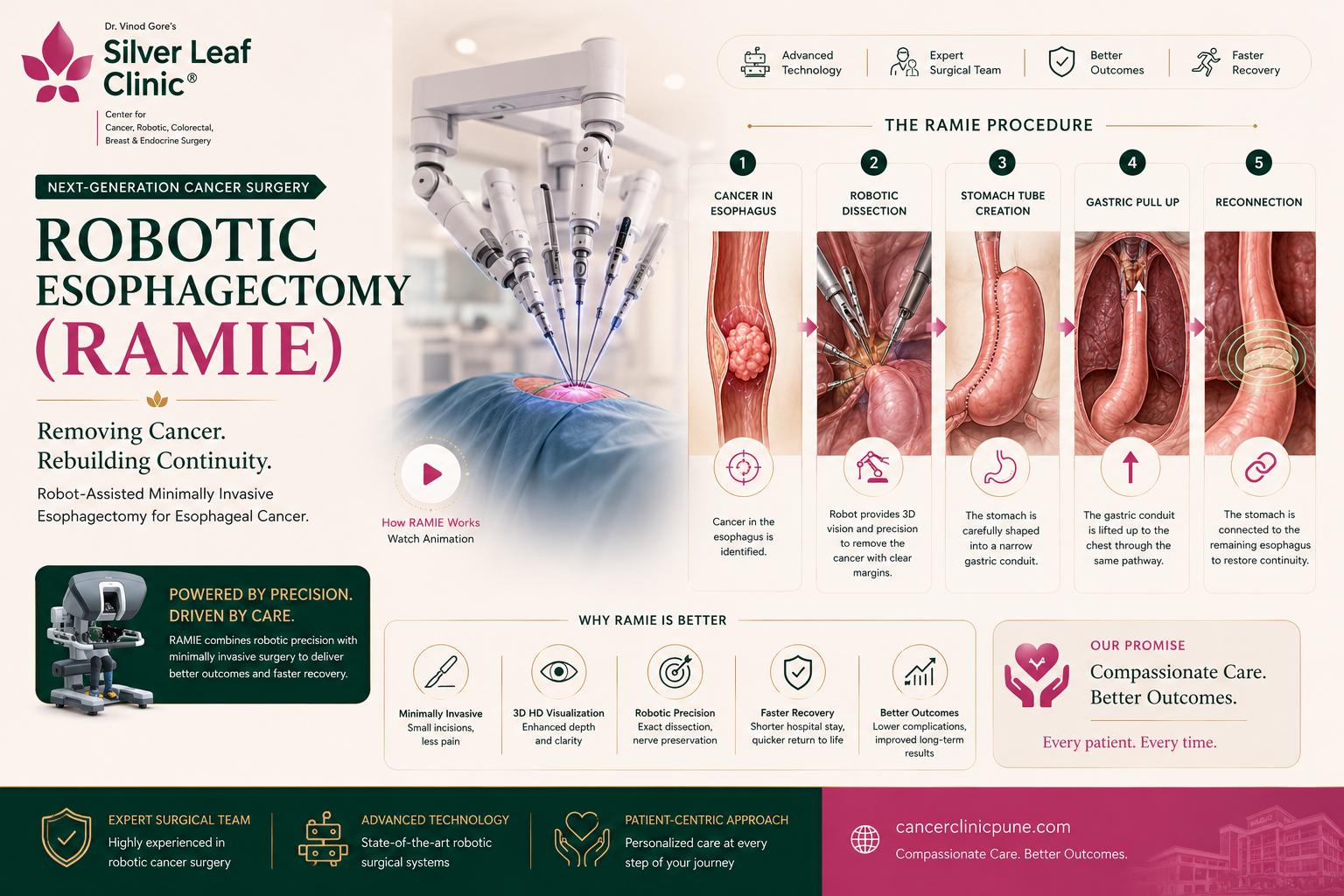
Robotic Radical Gastrectomy with D2 lymphadenectomy
Curing stomach cancer depends on two things: removing the tumour with a clear margin, and clearing the right lymph nodes completely — a D2 lymphadenectomy. The robot makes the demanding D2 dissection more precise and, in many ways, easier.
See also: Stomach Cancer and Esophageal Cancer condition pages.
Robotic vs open — oesophagus & stomach
A balanced summary for upper-GI cancer surgery. The robot is an excellent tool in suitable cases; the right choice is always made for the individual patient.
| Factor | Robotic (da Vinci Xi) | Open surgery |
|---|---|---|
| Vision | Magnified 3-D, ten-times view | Direct naked-eye view |
| Precision & reach | Wristed, tremor-free, deep access | Excellent, with direct touch |
| Incisions & pain | Small ports, less pain | Larger incision, more initial pain |
| Blood loss | Typically less | More in complex cases |
| D2 / chest node dissection | Precise, thorough, easier in tight spaces | Effective; harder in deep, confined areas |
| Recovery | Usually faster | Somewhat slower |
| Cancer outcome | Equivalent (or better clearance) | Proven, equivalent |
| Best for | Most suitable oesophageal & gastric cancers | Very advanced/complex or specific situations |
For the situations where open surgery is the better choice, see our Open Cancer Surgery page. Colon and rectal robotic surgery are covered separately on the Robotic Rectal Surgery page.
Robotic GI surgery — answered plainly
This page is general information, not personal medical advice. Whether robotic surgery is right for you depends on your tumour and overall health, decided at a multidisciplinary tumour board. Please bring all scans and reports to your consultation.
Ask about robotic GI cancer surgery
If you or a family member has oesophageal or stomach cancer, Dr. Gore can advise whether robotic surgery is the best approach. Please bring all CT/MRI/PET scans, endoscopy and biopsy reports, and any previous operative notes — ideally on CD or shared via WhatsApp in advance.