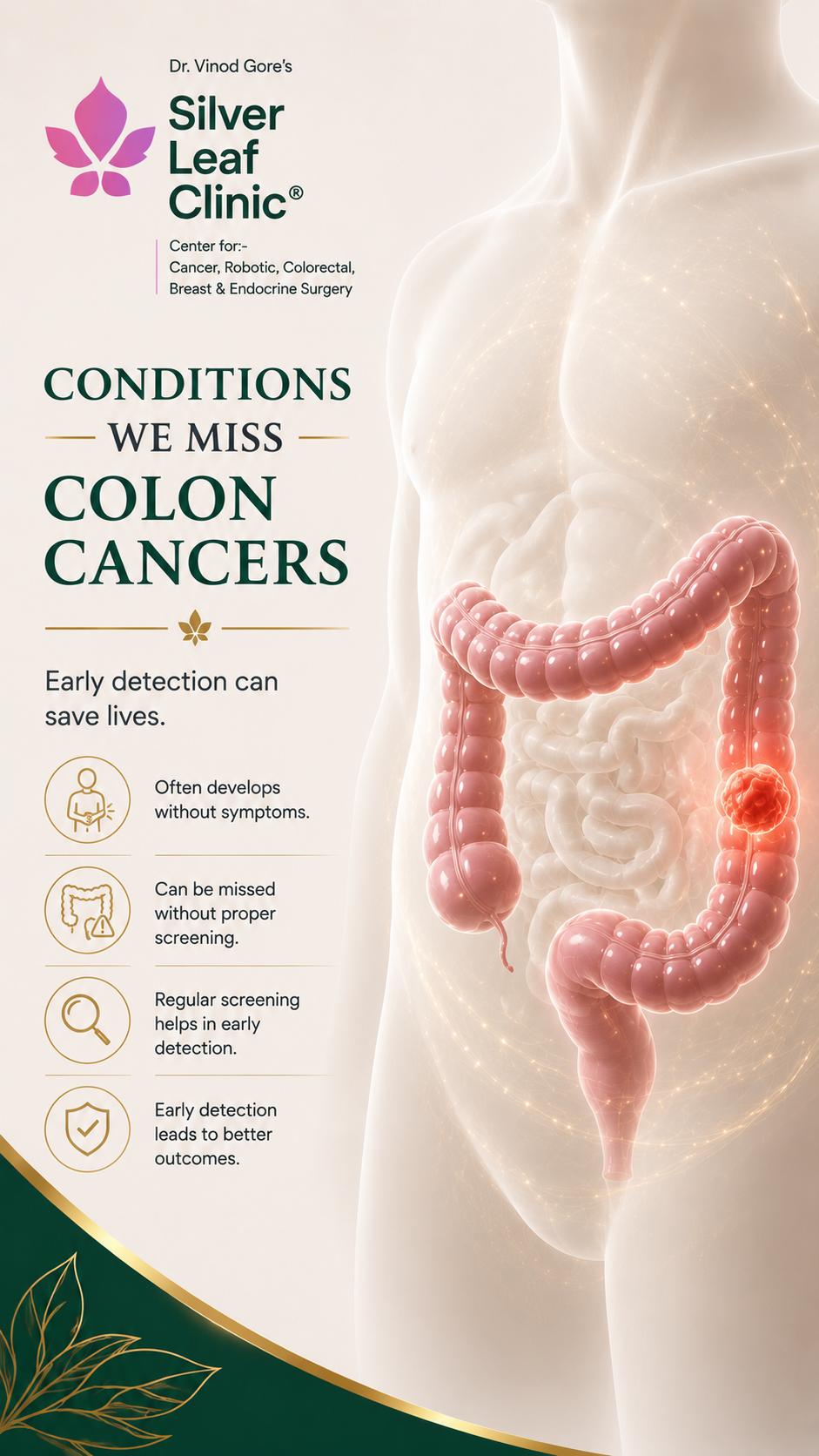
Dr. Vinod T. Gore performs robotic and open colectomy with Complete Mesocolic Excision (CME) and D3 lymphadenectomy — the highest-quality colon cancer operation available in Pune. Early-stage colon cancer carries a 93–95% cure rate.
The colon (large intestine) is approximately 150 cm of bowel running from the appendix to the rectum — divided into the ascending, transverse, descending, and sigmoid colon. Cancer develops when cells in the colon's lining mutate and multiply uncontrollably, typically beginning as small non-cancerous growths called polyps that can transform into cancer over 10–15 years.
Colon cancer is one of the most common cancers worldwide — and in India its incidence is rising rapidly, increasingly affecting patients under 50. It is also one of the most preventable and curable cancers when detected early. Regular colonoscopy screening identifies and removes polyps before they become cancerous — preventing colon cancer entirely.
The sigmoid colon is the most common site (~40%), followed by the ascending colon (~25%), transverse colon (~15%), and descending colon (~10%). The specific operation depends on tumour location, stage, and patient health.
Many early colon cancers cause no symptoms at all — which is why screening is essential. When symptoms appear, investigate promptly.
Staging is determined by CT scan and CEA blood test before surgery, confirmed by the pathology report post-operatively.
| Stage | Classification | Description & Treatment | 5-yr Survival |
|---|---|---|---|
Stage I | T1–T2, N0, M0 | Tumour confined to colon wall. Surgery alone curative. No adjuvant chemotherapy required. | 93–95% |
Stage II | T3–T4, N0, M0 | Grown through wall, no nodes. Surgery primary. Chemo for high-risk features only (T4, obstruction, perforation, <12 nodes). | 75–87% |
Stage III | Any T, N+, M0 | Regional lymph node spread. Surgery + 6 months FOLFOX or CAPOX adjuvant chemotherapy standard of care. | 53–74% |
Stage IV | Any T, Any N, M1 | Distant metastases — liver, lung, peritoneum. Coordinated systemic therapy + surgery. Liver mets may be resectable for cure. | Variable 10–35%+ |
Not all colectomies are equal. CME with D3 lymphadenectomy — as practised by Dr. Gore — is the highest-quality colon cancer operation, delivering measurably better staging accuracy and long-term survival.
Dr. Gore uses the ERAS (Enhanced Recovery After Surgery) protocol — an evidence-based pathway that reduces hospital stay, complications, and time to full recovery.
In the vast majority of colon cancer operations, the bowel ends are joined immediately — no stoma is required. A temporary stoma may be needed if the join needs protection or in emergency surgery with contamination. Permanent stomas after colon cancer (not rectal) are uncommon.
The international minimum standard is 12 lymph nodes in the specimen. Dr. Gore's CME with D3 lymphadenectomy routinely retrieves 20–30+ — significantly improving staging accuracy and survival. Fewer than 12 nodes means the staging may be inaccurate and local recurrence risk is higher.
Stage I: no chemotherapy. Stage II: only for high-risk features (T4, perforation, obstruction, poor differentiation, <12 nodes). Stage III: 6 months FOLFOX or CAPOX is standard. Stage IV: systemic chemotherapy backbone, with surgery for resectable liver or peritoneal disease.
Yes — 20–25% have liver metastases at diagnosis; 40% develop them after resection. Surgical resection of colorectal liver metastases, combined with systemic chemotherapy, offers 30–50% 5-year survival in carefully selected patients. This is genuinely curative — not just palliative.
Robotic colectomy provides superior 3D vision for CME dissection, greater instrument flexibility for D3 vascular ties at the SMA/IMA root, better access to the splenic and hepatic flexures, and elimination of tremor. Node yields are consistently higher with robotic CME. Dr. Gore holds the FARIS (University of Edinburgh) and leads a designated Robotic Surgery Centre of Excellence.
Colonoscopy is a 20–30 minute examination of the entire large bowel. It is both diagnostic (for rectal bleeding, bowel changes, anaemia) and preventive — polyps found can be removed immediately before they become cancerous. Recommended from age 45 for all adults, and from age 40 (or 10 years before the youngest affected relative) if family history exists.
Bring your CT scan, colonoscopy report, and biopsy result. Dr. Gore will review your case and recommend the optimal operation for your tumour location and stage.