📞 88558 10010 (Silver Leaf Clinic) 📞 +91 20 6768 9704 (Landline) 📞 84118 08284 (Direct / WhatsApp)
Silver Leaf Clinic · Hadapsar, Pune
HomeConditionsGIST Tumours
GI Sarcoma · GIST · Pune

GIST — Surgery & Targeted Therapy

Gastrointestinal Stromal Tumour · Robotic Resection · Imatinib

GIST is a different kind of GI tumour — a sarcoma driven by a specific gene mutation, and one of the great success stories of precision medicine. It does not respond to ordinary chemotherapy or radiation, but to targeted therapy, combined with surgery. Dr. Vinod T. Gore performs robotic, organ-preserving resection of GIST alongside modern targeted treatment.

Robotic Organ-Preserving Resection Targeted Therapy (Imatinib) CD117 / KIT & PDGFRA FARIS Edinburgh
Rectal Cancer Surgery - Dr. Vinod T. Gore
~80%
Driven by a KIT mutation (CD117 positive)
Surgery
Curative for localised GIST
3 yrs
Adjuvant imatinib for high-risk tumours
300+
Robotic procedures by Dr. Gore
Understanding GIST

What is a GIST?

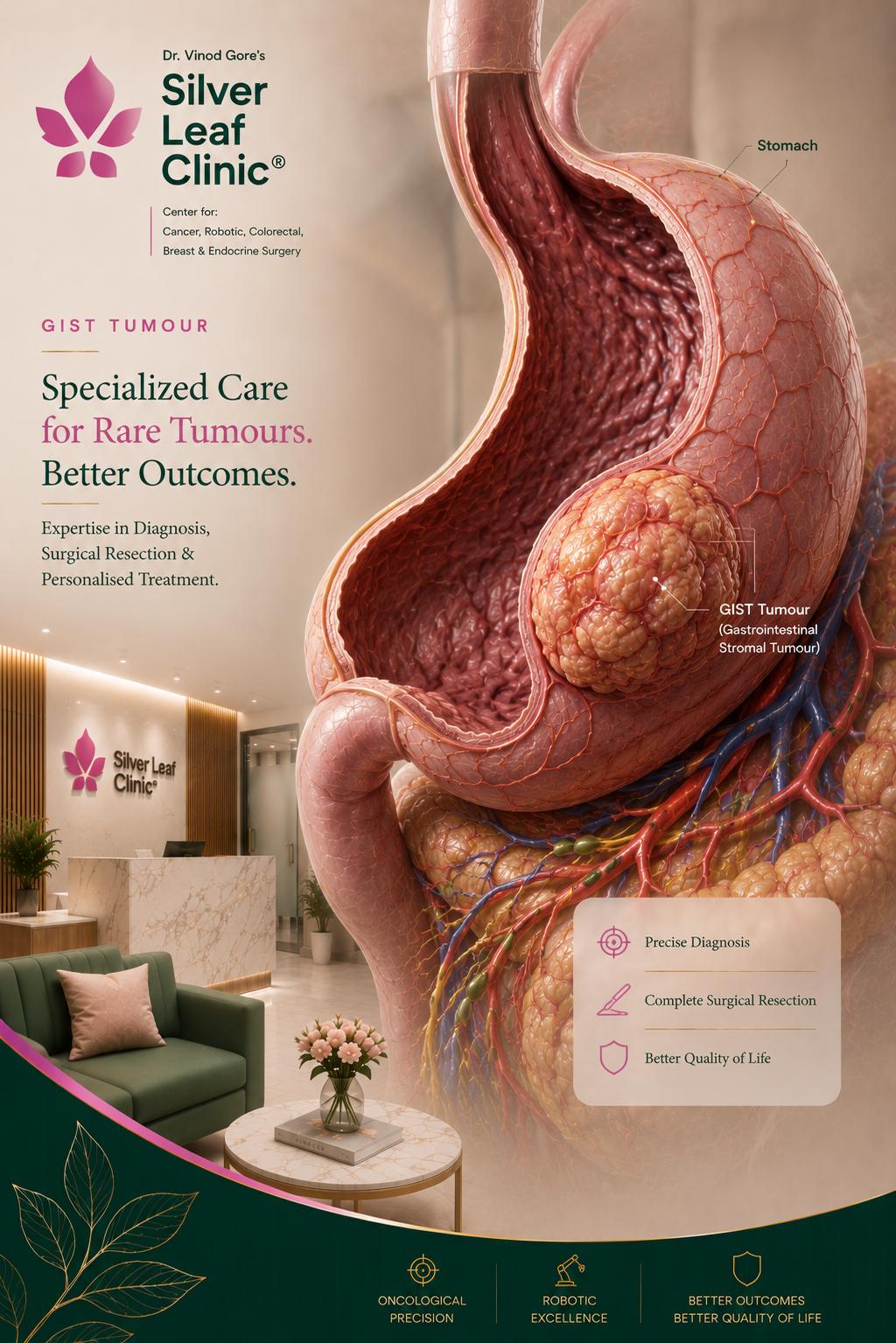
A gastrointestinal stromal tumour (GIST) is the most common sarcoma of the digestive tract. It grows from the ‘interstitial cells of Cajal’ — the pacemaker cells in the gut wall that control its movement — and so it behaves quite differently from the common carcinomas of the stomach or bowel.

Most GISTs are driven by a mutation in a single gene — usually KIT (which makes the tumour CD117-positive) or PDGFRA. This discovery transformed treatment: GIST does not respond to ordinary chemotherapy or radiotherapy, but it responds remarkably well to a tablet that blocks that faulty gene — imatinib.

GISTs are most common in the stomach, then the small intestine, and can range from tiny, harmless nodules to large, aggressive tumours. Importantly, GIST rarely spreads to lymph nodes — so surgery can usually be organ-preserving, without the wide lymph node dissection needed for carcinomas.

GIST Is Different
Cajal
Arises from the gut’s pacemaker cells — a sarcoma, not a carcinoma
KIT
Driven by a KIT or PDGFRA gene mutation (CD117 positive)
No RT
Does not respond to ordinary chemotherapy or radiotherapy
Target
Responds to targeted therapy — imatinib and related drugs
No nodes
Rarely spreads to lymph nodes — surgery can preserve the organ
Causes & Genetics

What causes GIST?

Unlike most GI cancers, GIST is not caused by lifestyle — not by smoking, alcohol or diet. Almost all GISTs arise from a random gene mutation acquired during life. Knowing which mutation is present is essential, because it guides the choice and dose of targeted therapy.

KIT mutation
About 75–80% — CD117 positive. Usually responds very well to imatinib (especially exon 11).
PDGFRA mutation
About 10% — one subtype (D842V) resists imatinib and is treated with avapritinib instead.
SDH-deficient / wild-type
No KIT/PDGFRA mutation — often younger patients, stomach, sometimes part of Carney triad.
NF1 / BRAF
Rare — GIST linked to neurofibromatosis type 1 or BRAF mutation.

Mutation testing is essential. A small minority of GISTs are inherited (familial GIST, or as part of syndromes such as neurofibromatosis type 1 or the Carney triad) — these patients and their families benefit from genetic counselling.

Warning Signs

Symptoms of GIST

Small GISTs often cause no symptoms and are discovered incidentally. Larger ones tend to bleed or cause a mass and discomfort.

Bleeding into the gut — causing anaemia, tiredness or black stools
A lump or mass in the abdomen that can sometimes be felt
Vague abdominal discomfort, pain or a feeling of fullness
Feeling full quickly when eating (early satiety)
Nausea, or rarely vomiting if the tumour blocks the gut
Often none at all — many GISTs are found by chance on a scan or endoscopy
A GIST found incidentally still needs proper assessment. Its behaviour — and whether treatment is needed — depends on its size, where it is, and how fast its cells are dividing (the mitotic rate), not on symptoms alone.
Risk Assessment

How aggressive is it? — risk stratification

GIST is not staged like a carcinoma. Instead, the risk of it coming back after surgery is judged from three things: the tumour’s size, how fast its cells divide (the mitotic rate), and its location — plus whether it ruptured. This risk decides whether targeted therapy is needed after surgery.

Risk GroupTypical FeaturesApproach After Surgery
Very Low / Low
Small tumour (under ~5 cm) with a low mitotic rateSurgery alone — usually cured
Intermediate
Moderate size or mitotic rate; gastric tumours behave better than small-bowel onesSurgery; adjuvant imatinib considered case-by-case
High
Large (>5–10 cm), high mitotic rate, small-bowel site, or any tumour ruptureSurgery + 3 years adjuvant imatinib

Gastric GISTs generally behave more favourably than small-intestinal GISTs of the same size and mitotic rate. A tumour that ruptures — before or during surgery — is treated as high risk, which is why intact removal is so important.

Treatment Pathway

From diagnosis to cure

GIST care combines precise surgery with targeted therapy, sequenced according to the tumour’s risk and mutation.

01
Step 01
Diagnosis & Mutation Testing
Endoscopy, endoscopic ultrasound (EUS) and a needle biopsy confirm GIST (CD117/DOG1 positive). Mutation testing (KIT/PDGFRA) is done because it guides the targeted therapy.
02
Step 02
MDT Planning
A sarcoma-aware multidisciplinary tumour board agrees the plan based on size, site, mutation and risk.
03
Step 03
Neoadjuvant Imatinib (If Needed)
For large or awkwardly-placed tumours — for example near the rectum or the food pipe — imatinib is given first to shrink the tumour, allowing smaller, organ-preserving surgery.
04
Step 04
Surgery
Complete removal of the tumour with a clear margin, keeping the tumour intact (no rupture) — usually robotic and organ-preserving, without lymph node dissection.
05
Step 05
Risk Assessment
The removed tumour is assessed for size, mitotic rate and rupture to determine the risk of recurrence.
06
Step 06
Adjuvant Imatinib & Follow-up
High-risk patients take imatinib for 3 years (sometimes longer) to prevent recurrence, with regular scan surveillance.
Surgical Treatment

Surgery for GIST — complete but conservative

Because GIST rarely spreads to lymph nodes, the surgical goal is simply to remove the tumour completely, with a clear margin, while keeping it intact — which means surgery can usually preserve the organ and its function.

Preferred Approach · Robotic
Robotic, Organ-Preserving Resection
Intact Removal · No Rupture · No Node Dissection

The two rules of GIST surgery are a clear margin and an intact tumour — because rupturing the tumour spills cells and dramatically worsens the outlook. The robot is ideally suited to this: the magnified 3D view and gentle, wristed handling allow a precise wedge resection that removes the tumour whole, with minimal disturbance and maximum preservation of the healthy organ. As GIST does not require the wide lymph node clearance of a carcinoma, most patients keep most of their stomach or bowel — and recover quickly.

Gastric GIST · Most Common
Wedge / Partial Gastrectomy
Removes the part of the stomach wall containing the tumour with a clear margin, preserving most of the stomach. Ideal for the robotic approach — most gastric GISTs need nothing more.
  • Stomach largely preserved
  • No lymph node dissection needed
  • Excellent robotic / minimal-access option
  • Clear margin with the tumour kept intact
Small Intestinal GIST
Small Bowel Resection
Removes the segment of small intestine containing the tumour and rejoins the bowel. Small-bowel GISTs behave more aggressively, so complete removal is key.
  • Segment removed & bowel rejoined
  • No routine node dissection
  • Robotic or laparoscopic where suitable
  • Adjuvant imatinib often advised
Lower GI GIST
Rectal GIST — Organ Preservation
For GIST of the rectum, imatinib is often given first to shrink the tumour, allowing a local, sphincter-preserving excision and avoiding a major resection or permanent stoma.
  • Imatinib first to downsize
  • Sphincter / organ preservation
  • Avoids major resection where possible
  • Tailored, function-sparing surgery
Targeted Therapy

Imatinib — precision medicine

GIST is the tumour that proved targeted therapy could transform cancer care. Imatinib, a daily tablet, blocks the faulty KIT/PDGFRA protein that drives the tumour. It is used in three ways: before surgery to shrink large tumours, after surgery for three years in high-risk cases to prevent recurrence, and as the main treatment for advanced disease. Mutation testing guides the dose and the drug.

Lines of Therapy for Advanced GIST
First Line
Imatinib
The standard first treatment for advanced GIST — effective for most KIT mutations.
Second Line
Sunitinib
Used if the GIST stops responding to imatinib.
Third Line
Regorafenib
For tumours that progress on imatinib and sunitinib.
Fourth Line
Ripretinib
A further option for advanced, resistant GIST.
The Evidence

Treatment options — what the trials show

GIST is the model for modern precision oncology — its care is built on landmark trials of targeted therapy combined with sound surgery.

Imatinib in Metastatic GIST
NEJM, 2002 (Demetri)
The landmark study that transformed GIST from a chemotherapy-resistant cancer with a dismal outlook into a controllable disease — the first great success of targeted therapy in solid tumours.
ACOSOG Z9001
Lancet, 2009
The first trial to show that one year of imatinib after surgery reduces the risk of GIST coming back, for tumours 3 cm or larger.
SSG XVIII / AIO
JAMA, 2012
The pivotal trial establishing three years of adjuvant imatinib as standard for high-risk GIST — improving 5-year recurrence-free survival (71% vs 53%) and overall survival (92% vs 86%) compared with one year.
Beyond Imatinib
GRID, INVICTUS & others
When GIST becomes resistant, further targeted drugs — sunitinib, regorafenib and ripretinib — each extend disease control, giving patients multiple effective options.
Mutation-Matched Therapy
NAVIGATOR & guidelines
Matching the drug to the mutation matters — avapritinib is highly effective for the PDGFRA D842V mutation that does not respond to imatinib.
Avoiding Rupture
SSG XVIII analysis
Tumour rupture markedly worsens outcome (10-year recurrence-free survival around 21% vs 55%) — the evidence behind the surgical rule of removing GIST intact.

References: Demetri GD et al., N Engl J Med 2002. ACOSOG Z9001 — Dematteo RP et al., Lancet 2009. SSG XVIII/AIO — Joensuu H et al., JAMA 2012; 10-year follow-up 2020. Newer agents: GRID (regorafenib) 2013, INVICTUS (ripretinib) 2020, NAVIGATOR (avapritinib). This information is educational and does not replace a personal consultation.

Patient Questions

Frequently asked questions — GIST

Is a GIST cancer, and is it the same as stomach cancer?+

A GIST is a type of cancer — a sarcoma — but it is quite different from the common stomach or bowel cancers (carcinomas), even when it grows in the stomach. It comes from a different cell type, is driven by a specific gene mutation, and is treated differently. So a ‘GIST of the stomach’ is not the same as ‘stomach cancer’.

Does GIST respond to chemotherapy or radiotherapy?+

No — and this is a crucial point. GIST does not respond to ordinary chemotherapy or radiotherapy. Instead it responds to targeted therapy (imatinib and related drugs) that blocks the specific faulty protein driving it. This is why correct diagnosis and mutation testing matter so much.

Will I need to take imatinib, and for how long?+

It depends on the risk. Patients whose tumour is completely removed and at low risk usually need no drug treatment. High-risk patients take imatinib for three years after surgery (sometimes longer) to prevent recurrence. In advanced disease, imatinib is the main, ongoing treatment.

Can GIST be cured?+

Yes — a localised GIST that is completely removed intact is often cured, especially low-risk tumours. Even when GIST is advanced, targeted therapy can control it effectively for a long time.

Why is mutation testing so important?+

Because it guides treatment. Most KIT mutations respond well to standard-dose imatinib; KIT exon 9 mutations need a higher dose; and the PDGFRA D842V mutation does not respond to imatinib at all and is treated with avapritinib. Testing ensures you get the right drug at the right dose.

Is robotic surgery suitable for GIST?+

Very much so. Because GIST does not require a wide lymph node dissection, surgery can be focused on removing just the tumour with a clear margin — ideal for a precise, organ-preserving robotic wedge resection. The key is to remove the tumour whole, without rupturing it.
Book a Consultation

GIST consultation, Pune

Bring your endoscopy, biopsy and CT reports — and the mutation result if you have it. Dr. Gore reviews everything personally and explains the right balance of organ-preserving surgery and targeted therapy for your tumour.

📍 Silver Leaf Clinic
511, City Centre, Solapur Road, Opp. Vaibhav Theatre, Hadapsar, Pune 411028
📍 Open in Google Maps
OPD Hours
Monday – Saturday10:00 AM – 6:00 PM
SundayBy Appointment
GIST treatment Pune · GIST surgery · neuroendocrine tumour treatment Pune · NET surgery · carcinoid tumour treatment · anal cancer treatment Pune · anal canal cancer · ICG fluorescence surgery · fluorescence guided surgery