๐Ÿ“ž 88558 10010 (Silver Leaf Clinic) ๐Ÿ“ž +91 20 6768 9704 (Landline) ๐Ÿ“ž 84118 08284 (Dr. Gore Direct / WhatsApp)
Silver Leaf Clinic ยท Hadapsar, Pune
Homeโ€บConditionsโ€บEsophageal Cancer
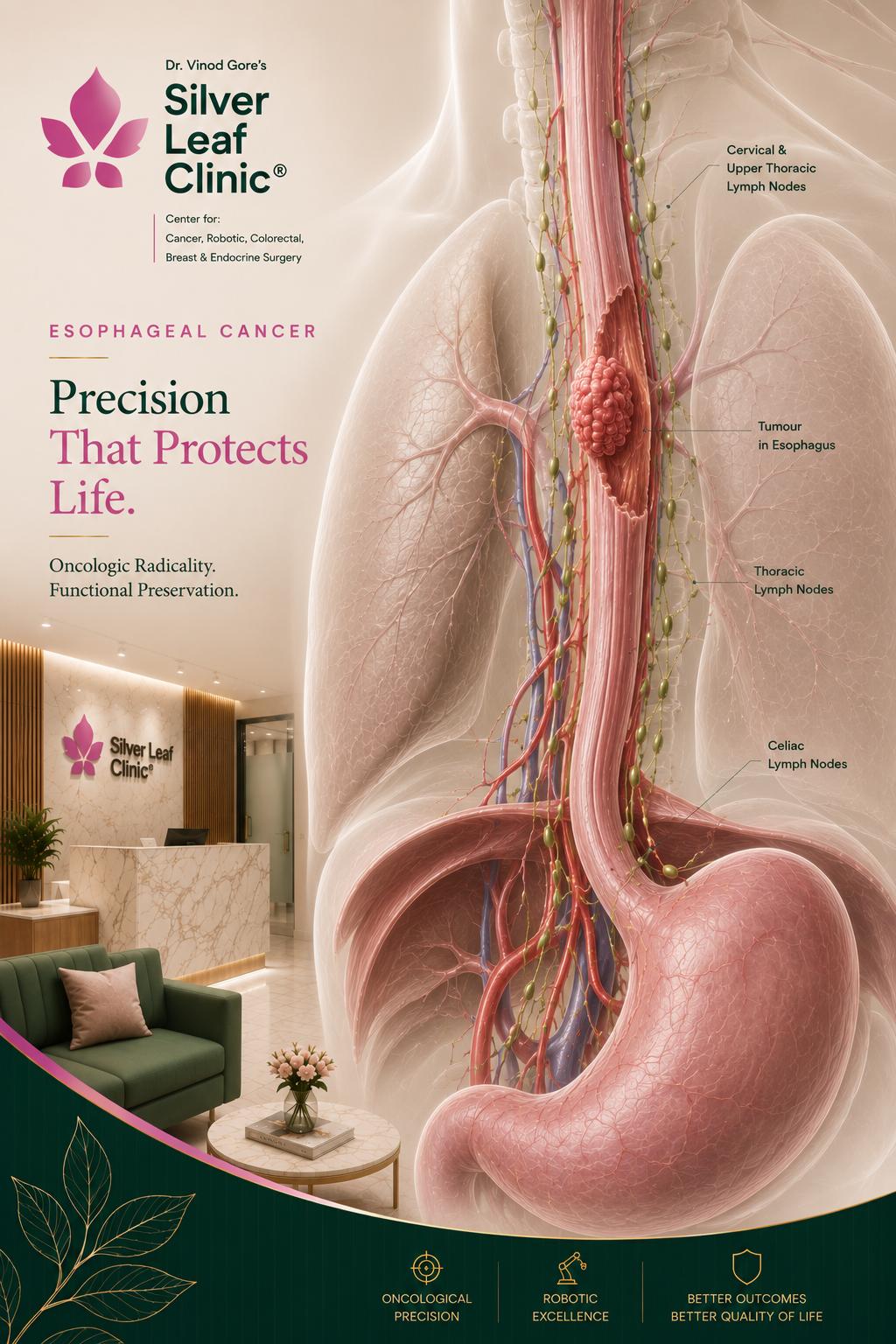
GI Cancer ยท Esophageal Cancer Surgery Pune

Esophageal
Cancer โ€”
RAMIE, Pune.

Robotic esophagectomy (RAMIE) offers its greatest advantage in esophageal cancer โ€” where the narrow mediastinum, recurrent laryngeal nerve preservation, and complex anastomosis make robotic precision not just beneficial, but transformative. Dr. Vinod T. Gore performs RAMIE for both SCC and Adenocarcinoma of the esophagus.

๐Ÿค– RAMIE ยท da Vinci Xi ยท FARIS ๐Ÿ† Maximum Robotic Advantage SCC ยท Adenocarcinoma ยท Both Treated CROSS ยท FLOT ยท Neoadjuvant RLN Preservation ยท No Rib-Spreading
Esophageal Cancer โ€” Key Facts
RAMIE
Robotic Assisted Minimally Invasive Esophagectomy
Primary approach โ€” maximum robotic benefit
SCC
Squamous Cell Carcinoma
Upper/mid esophagus ยท CROSS protocol
ACA
Adenocarcinoma
Lower esophagus/GEJ ยท FLOT or CROSS
RLN
Recurrent Laryngeal Nerve
Preserved under 10ร— robotic vision
8โ€“12
Days hospital โ€” RAMIE
vs 12โ€“16 days open thoracotomy
Two Different Diseases โ€” Two Different Treatments

SCC vs Adenocarcinoma โ€” Understanding the Difference

Esophageal cancer is not one disease โ€” it is two biologically and clinically distinct cancers that happen to arise in the same organ. Treatment strategy, chemotherapy protocol, and surgical approach differ significantly between them.

Risk Factors & Causes
    Treatment Approach

    Warning Signs

    Symptoms of Esophageal Cancer

    Progressive difficulty swallowing is the hallmark symptom of esophageal cancer. It is never normal and must be investigated immediately. By the time dysphagia develops, the tumour is often obstructing over 50% of the esophageal lumen.

    ๐Ÿฝ๏ธ
    Progressive dysphagia โ€” difficulty swallowing, starting with solids and progressing to liquids. This is the most common presenting symptom.
    โš–๏ธ
    Significant unexplained weight loss โ€” often 5โ€“10 kg or more by the time of diagnosis.
    ๐Ÿ˜ฃ
    Retrosternal chest pain or a sensation of food sticking behind the breastbone.
    ๐Ÿ—ฃ๏ธ
    Hoarseness or change in voice โ€” from recurrent laryngeal nerve involvement by the tumour.
    ๐Ÿ˜ฎโ€๐Ÿ’จ
    Chronic cough โ€” from tracheo-esophageal fistula or aspiration of regurgitated food.
    ๐Ÿคข
    Regurgitation of undigested food โ€” from proximal obstruction.
    ๐Ÿ˜“
    Fatigue and anaemia โ€” from blood loss or nutritional deficiency.
    โš ๏ธ
    Progressive difficulty swallowing is NEVER normal โ€” it must be investigated with endoscopy immediately, at any age.
    Staging

    Esophageal Cancer Stages & Treatment

    Full staging requires CT chest/abdomen/pelvis, PET-CT (essential โ€” identifies occult distant metastases in up to 15% of cases), and Endoscopic Ultrasound (EUS) for precise T and N staging.

    StageClassificationDescription & Approach5-yr Survival
    Stage I
    T1, N0, M0Tumour confined to mucosa or submucosa. Endoscopic resection (ESD/EMR) for T1a. Surgical esophagectomy for T1b with unfavourable features.75โ€“90%
    Stage II
    T2โ€“T3, N0โ€“N1Tumour into muscle layer or beyond, with limited nodal spread. CROSS chemoradiation followed by esophagectomy is standard.35โ€“55%
    Stage III
    T3โ€“T4a, N1โ€“N3Locally advanced. CROSS (SCC/ACA) or FLOT (ACA) neoadjuvant therapy followed by esophagectomy. Aim for complete R0 resection.15โ€“35%
    Stage IV
    Any T, Any N, M1Distant metastases. Systemic chemotherapy ยฑ immunotherapy (pembrolizumab for PD-L1+). Surgery palliative only.<10%
    Treatment Pathway

    From Diagnosis to Recovery

    Every resectable esophageal cancer follows a structured neoadjuvant pathway โ€” CROSS or FLOT chemotherapy before surgery, followed by RAMIE and adjuvant therapy. Every decision is made at the MDT tumour board.

    01
    Step 01
    Endoscopy & Staging
    Upper GI endoscopy with multiple biopsies. Endoscopic ultrasound (EUS) for precise T and N staging. CT chest/abdomen/pelvis. PET-CT to exclude occult distant metastases. Diagnostic laparoscopy for lower esophagus/GEJ tumours.
    02
    Step 02
    MDT Tumour Board
    Every case presented at the MDT โ€” surgical, medical and radiation oncologists, radiologist, and gastroenterologist. The balance between neoadjuvant chemoradiation (CROSS), perioperative chemotherapy (FLOT), or definitive chemoradiation is decided here.
    03
    Step 03
    Neoadjuvant Therapy
    SCC: CROSS protocol โ€” Carboplatin + Paclitaxel + 41.4 Gy radiotherapy over 5 weeks. Adenocarcinoma: FLOT ร— 4 cycles (preferred for Siewert II/III GEJ tumours) or CROSS. Both protocols significantly improve R0 resection rates and survival.
    04
    Step 04
    Restaging & Response
    CT scan and repeat endoscopy 4โ€“6 weeks after neoadjuvant therapy. SCC complete clinical responders may be offered organ preservation. PET-CT assesses metabolic response. Surgical planning confirmed.
    05
    Step 05
    Robotic Esophagectomy
    RAMIE โ€” thoracoscopic + laparoscopic approach using the da Vinci Xi. Mediastinal lymph node dissection, RLN preservation, gastric conduit formation, and intrathoracic anastomosis performed robotically with 10ร— magnification.
    06
    Step 06
    Recovery & Adjuvant
    ICU 1โ€“2 days, ward 8โ€“12 days total hospital stay. Swallowing assessment before oral intake. Adjuvant FLOT (4 cycles, for ACA patients) begins 4โ€“6 weeks post-op. Nutritional support and dietitian follow-up throughout recovery.
    ๐Ÿค– RAMIE ยท da Vinci Xi ยท FARIS Edinburgh ยท Maximum Robotic Advantage
    Why Esophageal Cancer Has the
    Most to Gain from Robotic Surgery.

    Of all GI cancer operations, esophagectomy benefits most from the robotic platform. The thoracic esophagus runs through one of the most confined, dangerous spaces in the body. Open thoracotomy requires rib-spreading, causing severe post-operative respiratory pain. RAMIE eliminates all of this.

    The da Vinci Xi's 10ร— magnified 3D vision and 7-degree wristed instruments reach deep into the narrow mediastinum through 3โ€“4 small chest ports. Dr. Gore holds the FARIS Fellowship from the University of Edinburgh and leads Pune's designated Robotic Surgery Centre of Excellence.

    3โ€“4
    Small chest ports
    No rib-spreading
    10ร—
    Magnified 3D vision
    Deep in mediastinum
    RLN
    Preserved
    Under direct vision
    ICG
    Conduit perfusion
    Before anastomosis
    ๐Ÿ…
    FARIS โ€” University of Edinburgh
    Fellowship in Advanced Robotic & Innovative Surgery ยท One of very few in India
    โญ
    Centre of Excellence
    Sahyadri Manipal Hospital, Pune ยท ARIS accredited robotic cancer surgery centre
    ๐ŸŽ“
    FARIS Training Mentor
    Dr. Gore trains and certifies other robotic surgeons at the accredited centre
    8 Reasons RAMIE Outperforms Open Esophagectomy
    ๐Ÿ”ญ
    10ร— Vision in the Narrow Mediastinum
    The da Vinci's 10ร— magnified 3D HD view reveals anatomical planes and critical structures โ€” recurrent laryngeal nerves, thoracic duct, and azygos vein โ€” with clarity impossible in open thoracotomy.
    ๐Ÿฆพ
    7ยฐ Instruments Where Hands Cannot Go
    Robotic wristed instruments reach deep into the chest through small ports โ€” performing precise dissection without the major chest wound of rib-spreading thoracotomy.
    ๐Ÿ—ฃ๏ธ
    Recurrent Laryngeal Nerve Preservation
    The da Vinci's magnified view allows precise identification and preservation of both RLNs throughout the mediastinal dissection. RLN injury rates are significantly lower with RAMIE.
    ๐Ÿ’ง
    Thoracic Duct Identification & Ligation
    Robotic vision identifies the thoracic duct throughout its course โ€” allowing precise ligation or preservation. ICG fluorescence further assists thoracic duct mapping.
    ๐Ÿซ
    No Rib-Spreading โ€” Fewer Respiratory Complications
    Robotic surgery uses 3โ€“4 small thoracoscopic ports, eliminating rib-spreading and its respiratory consequences โ€” significantly reducing post-op pneumonia risk.
    ๐Ÿ’ก
    ICG Fluorescence โ€” Gastric Conduit Perfusion
    After creating the gastric conduit, ICG fluorescence confirms adequate blood supply before the anastomosis is created โ€” the most important step in preventing anastomotic leak.
    ๐ŸŽฏ
    Superior Mediastinal Lymph Node Clearance
    Robotic precision enables superior nodal clearance along the recurrent laryngeal nerve chain, subcarinal nodes, and paratracheal stations โ€” improving staging accuracy and survival.
    โšก
    Faster Recovery ยท Earlier Oral Intake
    Patients undergoing RAMIE recover significantly faster than open thoracotomy โ€” less pain, earlier mobilisation, earlier oral intake, and shorter hospital stay.
    Surgical Options

    Esophagectomy Procedures โ€” Which Operation?

    The choice of esophagectomy depends on the tumour location, histological type (SCC vs ACA), and patient fitness. All approaches are performed using robotic (RAMIE) or minimally invasive technique wherever possible.

    ๐Ÿฅ
    Mid & Lower Esophagus ยท Intrathoracic Anastomosis
    Robotic Ivor Lewis Esophagectomy
    Combines a laparoscopic abdominal phase with a right thoracoscopic phase. The anastomosis is created high in the right chest. Preferred for mid and lower esophageal cancers โ€” providing widest mediastinal node dissection.
    • Abdominal + right thoracoscopic phases
    • Intrathoracic anastomosis โ€” wide surgical field
    • Optimal for mid and lower esophageal cancer
    • Superior mediastinal lymphadenectomy
    • Most commonly performed RAMIE approach
    • ICG confirms conduit perfusion before anastomosis
    ๐Ÿ”บ
    Upper & Mid Esophagus ยท Cervical Anastomosis
    McKeown (3-Field) Esophagectomy
    Adds a cervical phase to the thoracoscopic and laparoscopic phases โ€” anastomosis is created in the neck. Used for upper and mid esophageal SCC where cervical anastomosis provides better proximal clearance.
    • 3 phases: thoracoscopic + laparoscopic + cervical
    • Cervical anastomosis โ€” superior proximal margin
    • Preferred for upper and mid esophageal SCC
    • 3-field nodal clearance
    • Anastomotic leak in neck is less dangerous
    • Lower risk of fatal mediastinitis if leak occurs
    ๐Ÿ”ฝ
    Lower Esophagus & GEJ ยท No Thoracic Phase
    Transhiatal Esophagectomy
    Removes the esophagus through the abdominal hiatus without entering the chest. Suitable for lower esophageal and GEJ adenocarcinoma in selected patients with significant pulmonary comorbidity.
    • No thoracic incision โ€” avoids thoracotomy
    • Suitable for lower esophagus and GEJ ACA
    • Preferred for patients with poor pulmonary reserve
    • Blunt mediastinal dissection โ€” limited nodal clearance
    • Cervical anastomosis reduces leak severity
    • Robotic-assisted transhiatal is now feasible
    Reconstruction

    Replacing the Esophagus โ€” Reconstruction Options

    After the esophagus is removed, the digestive tract must be reconstructed to restore the ability to eat. The stomach (as a gastric conduit) is used in over 90% of cases. ICG fluorescence is used to confirm conduit blood supply before the anastomosis.

    Gastric Conduit
    Standard โ€” used in >90% of esophagectomies
    The stomach is fashioned into a long tube (conduit) using a linear stapler, preserving the right gastroepiploic vessels. It reaches the chest or neck easily and has a reliable blood supply. ICG fluorescence is used to confirm perfusion at the tip before the anastomosis. The gold standard reconstruction.
    Colonic Interposition
    When stomach is unavailable (prior gastrectomy)
    A segment of the colon is brought up through the chest to replace the esophagus. Technically demanding โ€” requires three anastomoses. Blood supply must be confirmed with Doppler and ICG. Used when the stomach has been previously removed or is unusable.
    Jejunal Interposition
    Short-segment reconstruction ยท proximal lesions
    A pedicled or free jejunal segment is used for very proximal esophageal reconstruction or when both stomach and colon are unavailable. Rarely used for full esophageal replacement โ€” more commonly for pharyngo-esophageal junction reconstruction.
    Patient Questions

    Frequently Asked Questions โ€” Esophageal Cancer

    Book a Consultation
    Esophageal Cancer
    Consultation,
    Pune.

    Bring your CT scan, PET-CT, endoscopy report, EUS result, and biopsy with HER2 report. Dr. Gore will review everything at the first consultation and outline the full treatment plan โ€” CROSS or FLOT, RAMIE, and adjuvant therapy.

    ๐Ÿ“ Silver Leaf Clinic
    511, City Centre, Solapur Road, Opp. Vaibhav Theatre, Hadapsar, Pune 411028
    ๐Ÿ“ Open in Google Maps
    Dr. Vinod Gore's
    Silver Leaf Clinicยฎ
    Esophageal Cancer ยท RAMIE ยท SCC ยท Adenocarcinoma ยท CROSS ยท FLOT
    Consultations at Silver Leaf Clinic, Hadapsar. RAMIE performed at Sahyadri Manipal Hospital โ€” Pune's Robotic Cancer Surgery Centre of Excellence.
    Monday โ€“ Saturday10:00 AM โ€“ 6:00 PM
    SundayBy Prior Appointment
    Landline+91 20 6768 9704
    Call Silver Leaf Clinic
    88558 10010
    Call โ†’