📞 88558 10010 (Silver Leaf Clinic) 📞 +91 20 6768 9704 (Landline) 📞 84118 08284 (Direct / WhatsApp)
Silver Leaf Clinic · Hadapsar, Pune
HomeConditionsAnal Cancer
Anorectal Cancer · Anal Canal Cancer · Pune

Anal Cancer & Organ Preservation

Chemoradiation First · Sphincter-Preserving · Surgery Reserved for Salvage

Anal canal cancer is one of the few cancers usually cured without major surgery. The primary treatment is organ-preserving chemoradiation — most patients keep their sphincter and avoid a permanent colostomy. Dr. Vinod T. Gore coordinates this multidisciplinary care and performs salvage and reconstructive surgery when it is needed.

Organ Preservation — Most Cases Chemoradiation First (Nigro Protocol) Sphincter Preserved — No Bag Salvage Surgery When Needed
Rectal Cancer Surgery - Dr. Vinod T. Gore
80%+
Cured with chemoradiation — no major surgery
Most
Keep the sphincter — no permanent bag
~90%
Linked to HPV — largely preventable
Salvage
Surgery reserved for residual / recurrent disease
Understanding Anal Cancer

What is anal cancer?

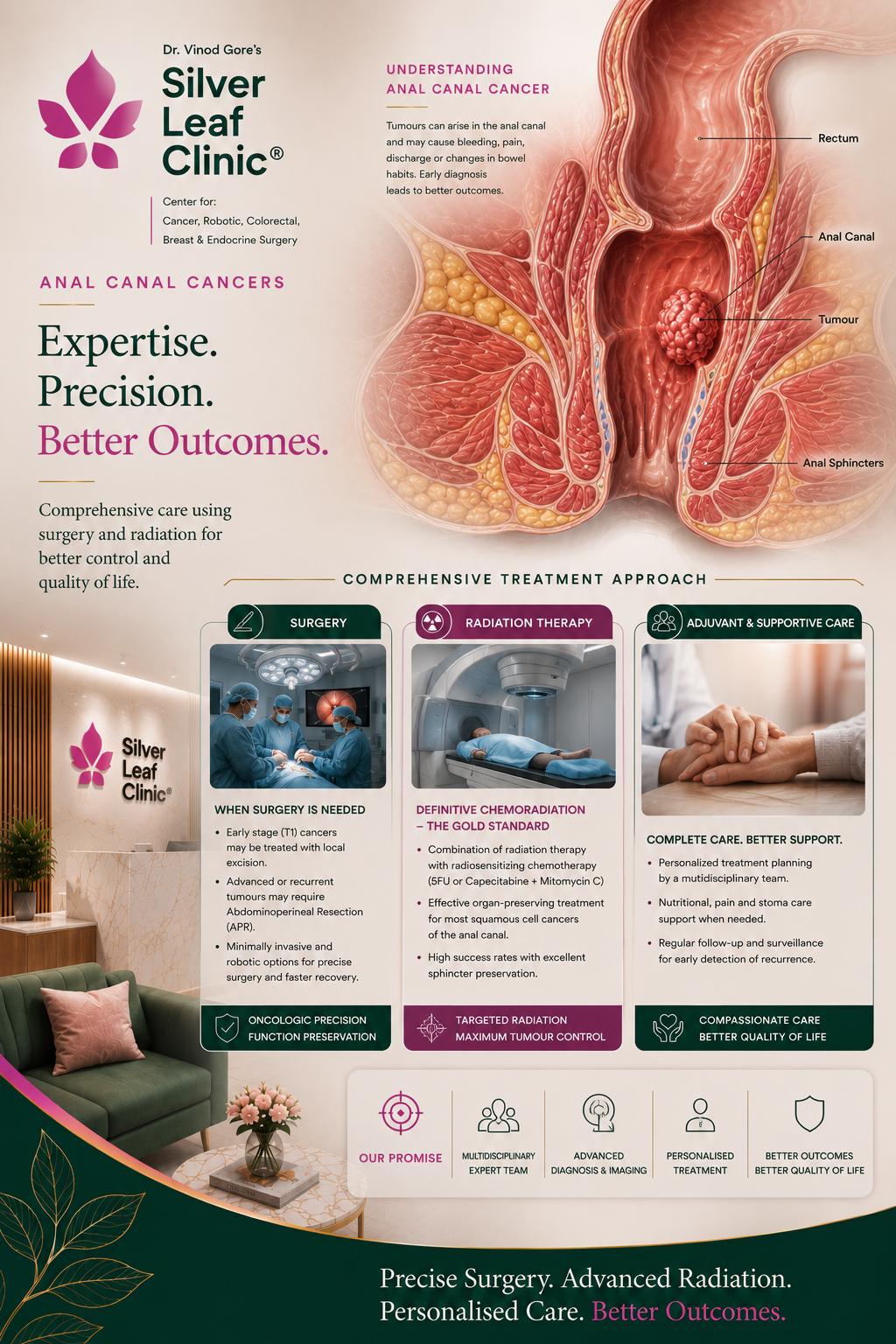
The anal canal is the short final passage of the bowel — about 3–4 cm long — that ends at the anal opening. Although it sits right next to the rectum, anal cancer is a different disease. Most anal cancers are squamous cell carcinomas, the same cell type as skin and cervix — not the glandular type seen in colon and rectal cancer.

This difference matters enormously, because it changes the treatment. Unlike colon or rectal cancer — where surgery comes first — anal cancer responds beautifully to a combination of chemotherapy and radiotherapy. This organ-preserving approach cures most patients while keeping the sphincter intact, so a permanent colostomy is usually avoided.

The great majority of anal cancers are linked to the human papillomavirus (HPV) — the same virus behind cervical cancer — which means much of it is preventable through HPV vaccination and screening of high-risk groups.

Key Facts
3–4
Centimetres — the length of the anal canal
SCC
Most are squamous cell carcinoma — not the glandular type of colon/rectal cancer
80%+
Cured by chemoradiation, keeping the sphincter
~90%
Linked to HPV — preventable by vaccination
Salvage
Surgery is reserved for disease that remains or returns
Causes & Risk Factors

What causes anal cancer?

Anal cancer is strongly linked to long-standing HPV infection. The risk factors below are discussed openly and without judgement — understanding them helps with prevention and early detection.

HPV infection
Most anal cancers are caused by the human papillomavirus, especially HPV-16.
HIV / immunosuppression
A weakened immune system — from HIV or anti-rejection drugs — raises the risk.
Smoking
Smoking significantly increases the risk and is also linked to poorer outcomes.
Other HPV-related cancers
A past history of cervical, vulvar or vaginal pre-cancer or cancer raises risk.
Sexual history
Receptive anal intercourse and a higher number of sexual partners increase HPV exposure.
Age
Most cases occur from the 50s onwards, though it can occur earlier.

Prevention matters. Because most anal cancers are HPV-related, the HPV vaccine substantially lowers the risk, and stopping smoking helps further. High-risk individuals may benefit from surveillance to catch pre-cancerous changes early.

Warning Signs

Symptoms of anal cancer

Anal cancer is very often mistaken for piles (haemorrhoids) or a fissure — which is why persistent symptoms must always be examined properly.

Bleeding from the anus or blood on the stool
A lump, swelling or growth at or near the anus
Anal pain, pressure or a persistent feeling of fullness
Itching, discharge or a non-healing sore around the anus
A change in bowel habit, or difficulty controlling the bowels
A lump in the groin (an enlarged lymph node)
Do not assume bleeding or a lump is ‘just piles’. Any anal symptom that does not settle — especially bleeding, a lump or pain — should be examined and, if needed, biopsied. Early anal cancer is highly curable.
Disease Staging

Anal cancer stages & outlook

Staging is based mainly on the size of the tumour and whether lymph nodes are involved. Assessment includes examination under anaesthesia, biopsy, pelvic MRI, CT or PET-CT, and an HIV test where appropriate.

StageClassificationDescription5-yr Survival
Stage I
T1 (≤2 cm), N0Small tumour confined to the anus. Chemoradiation is highly curative; tiny margin tumours may be locally excised.80–90%
Stage II
T2–T3 (>2 cm), N0Larger tumour, no nodes. Treated with chemoradiation, preserving the sphincter.70–80%
Stage III
Node-positive or T4Spread to nearby or groin lymph nodes, or invading nearby organs. Chemoradiation; salvage surgery if residual disease.50–65%
Stage IV
Any T, Any N, M1Spread to distant organs. Systemic chemotherapy, with radiotherapy or surgery for selected situations.Variable
Treatment Pathway

From diagnosis to cure

For anal cancer the order is different from colon and rectal cancer — treatment is led by chemoradiation, not surgery.

01
Step 01
Diagnosis & Staging
Examination (often under anaesthesia) with biopsy, pelvic MRI, CT or PET-CT, assessment of the groin nodes, and an HIV test where appropriate.
02
Step 02
MDT Planning
Every case is discussed at the multidisciplinary tumour board — surgical, medical and radiation oncologists together agree the plan.
03
Step 03
Chemoradiation (Primary)
The main curative treatment: combined chemotherapy (5-FU and mitomycin) with radiotherapy — the Nigro protocol — given over about 5–6 weeks. It preserves the sphincter and avoids a permanent stoma in most patients.
04
Step 04
Response Assessment
The tumour is reassessed clinically and on MRI around 8–12 weeks after treatment. Most patients achieve a complete response and need no surgery.
05
Step 05
Salvage Surgery (If Needed)
If cancer remains or returns, salvage surgery — usually abdominoperineal resection — offers a further chance of cure.
06
Step 06
Surveillance
Close follow-up with examination and imaging to detect and treat any recurrence early.
Treatment

Organ preservation — cure without losing function

The aim in anal cancer is to cure the disease while keeping the anus and sphincter working — so most patients never need a permanent bag. That is achieved with chemoradiation as the primary treatment, with surgery held in reserve.

Primary Treatment · Organ-Preserving
Chemoradiation (Nigro Protocol)
Chemotherapy + Radiotherapy · Sphincter Preserved

The cornerstone of anal cancer treatment is combined chemoradiation — chemotherapy (5-fluorouracil and mitomycin) given alongside radiotherapy, the approach pioneered by Dr. Norman Nigro. Delivered over about 5–6 weeks, it cures the great majority of patients while keeping the anus and sphincter intact, so a permanent colostomy is avoided. Dr. Gore, as surgical oncologist, leads the multidisciplinary team that plans and coordinates this care, monitors the response, and steps in surgically only if it is needed.

When surgery is needed

Dr. Gore performs the surgical procedures for anal cancer when chemoradiation does not fully clear the disease, or for selected early tumours.

Small Margin Tumours
Local Excision
For very small, superficial tumours at the anal margin, a simple local excision may be enough — removing the lesion with a clear margin while fully preserving function.
  • For small, well-defined margin tumours
  • Sphincter and function preserved
  • Often combined with surveillance
Residual or Recurrent Disease
Salvage APR
If cancer persists or returns after chemoradiation, abdominoperineal resection removes the anus, rectum and sphincter and creates a permanent colostomy — offering a further chance of cure. The abdominal part can be done by minimally-invasive or robotic surgery, with meticulous perineal dissection.
  • For disease remaining after chemoradiation
  • Robotic / minimally-invasive abdominal phase
  • Permanent stoma with full expert support
Involved Groin Nodes
Inguinal Node Dissection
When groin (inguinal) lymph nodes are involved and persist after treatment, they may be surgically removed to achieve disease control.
  • For persistent groin node disease
  • Careful, function-preserving technique
  • Part of a coordinated treatment plan
Patient Questions

Frequently asked questions — anal cancer

Can anal cancer be cured without surgery?+

Yes — for most patients. The main curative treatment is chemoradiation (chemotherapy with radiotherapy), which cures the majority while keeping the anus and sphincter intact. Surgery is only needed if the cancer does not fully clear or comes back.

Will I need a permanent colostomy bag?+

Usually not. Because anal cancer is treated mainly with chemoradiation rather than surgery, most patients keep their sphincter and never need a bag. A permanent colostomy is only required if salvage surgery (APR) becomes necessary.

Is anal cancer the same as rectal or colon cancer?+

No. Although the anus sits right next to the rectum, anal cancer is usually a squamous cell carcinoma (like skin or cervix), whereas colon and rectal cancers are glandular. This is why anal cancer is treated with chemoradiation first, not surgery first.

Is anal cancer caused by HPV, and can the vaccine prevent it?+

Most anal cancers are linked to the human papillomavirus (HPV) — the same virus that causes cervical cancer. The HPV vaccine substantially reduces the risk, and stopping smoking lowers it further.

It feels like piles — how do I know it isn’t cancer?+

You can’t tell from symptoms alone, which is exactly why persistent anal bleeding, a lump or ongoing pain should always be examined and, if needed, biopsied. Many anal cancers are first mistaken for haemorrhoids.

What is salvage surgery?+

Salvage surgery is an operation — usually abdominoperineal resection (APR) — offered when anal cancer remains or returns after chemoradiation. It removes the affected area completely and offers a further chance of cure.
Book a Consultation

Anal cancer consultation, Pune

Bring your biopsy report, MRI and any scans. Dr. Gore will review everything personally, coordinate your multidisciplinary care, and explain how organ preservation applies to you.

📍 Silver Leaf Clinic
511, City Centre, Solapur Road, Opp. Vaibhav Theatre, Hadapsar, Pune 411028
📍 Open in Google Maps
OPD Hours
Monday – Saturday10:00 AM – 6:00 PM
SundayBy Appointment