๐Ÿ“ž 88558 10010 (Silver Leaf Clinic) ๐Ÿ“ž +91 20 6768 9704 (Landline) ๐Ÿ“ž 84118 08284 (Dr. Gore / WhatsApp)
Silver Leaf Clinic ยท Hadapsar, Pune
Home
โ†’
About Dr. Gore
โ†’
Conditions
โ–ผ
Colon Cancer
Robotic & open colectomy
Rectal Cancer
Robotic TME ยท Sphincter preservation
Stomach Cancer
D2 gastrectomy ยท Robotic
Esophageal Cancer
RAMIE ยท CROSS ยท FLOT
Liver Cancer
Hepatectomy ยท CRLM
Pancreatic Cancer
Robotic Whipple ยท RAMPS
Anal Canal Cancer
Organ preservation
GIST Tumours
Resection + Imatinib
Neuroendocrine Tumours
Surgery ยท PRRT
Procedures
โ–ผ
Robotic Rectal Surgery
HIPEC Surgery
Sphincter Preservation
Stoma Care & Reversal
ICG Fluorescence
Whipple Procedure
Knowledge Hub
โ†’
Contact
โ†’
๐Ÿ“ž Call 88558 10010
Homeโ€บConditionsโ€บLiver Cancer
GI Oncology ยท Liver Cancer Surgery Pune

Liver Cancer &
Liver Metastases โ€”
Hepatectomy, Pune.

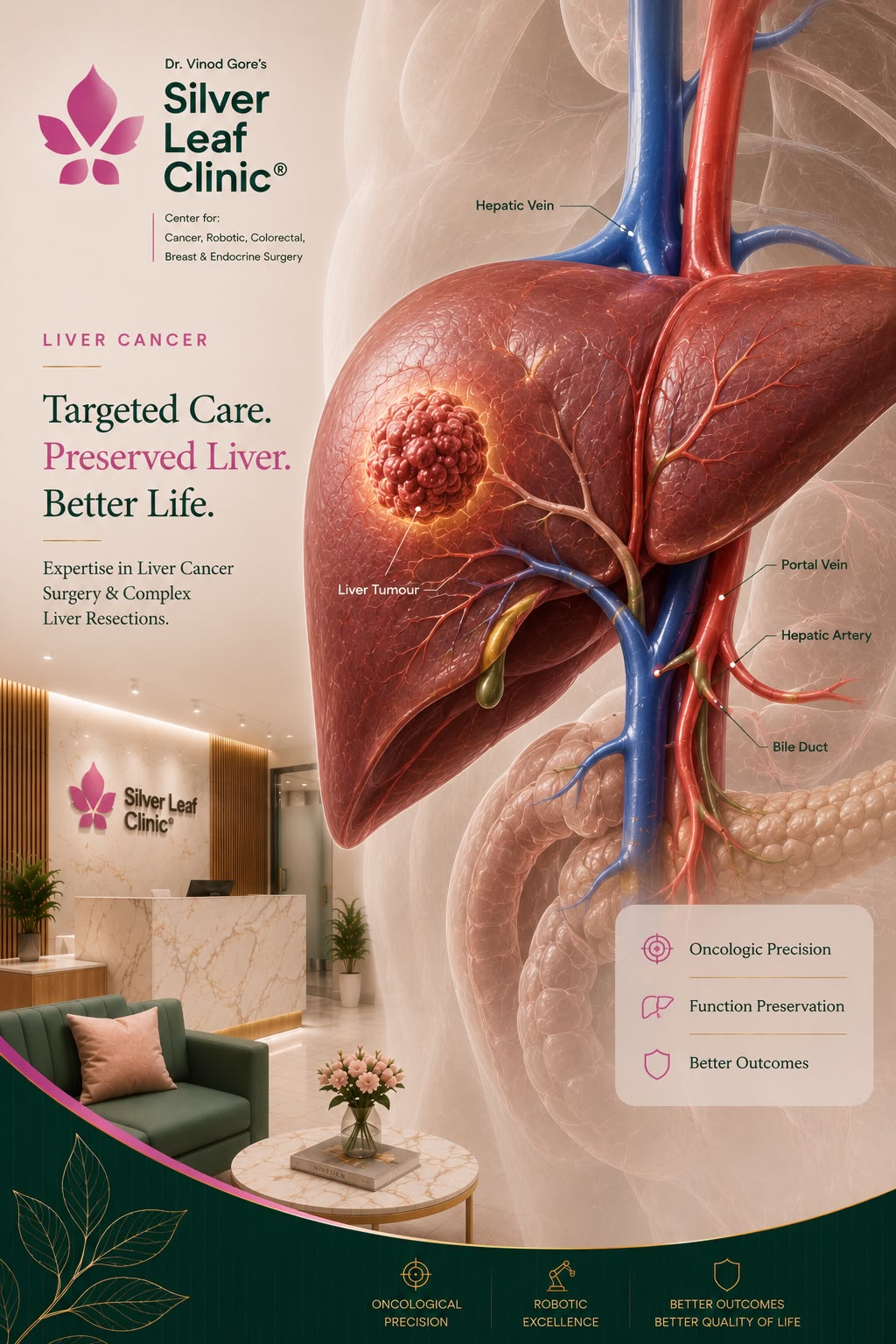
Surgical resection is the only treatment that offers long-term cure for liver tumours โ€” whether primary liver cancer (HCC, cholangiocarcinoma) or liver metastases from colorectal, neuroendocrine, or other GI cancers. Many patients told their liver tumour is inoperable are successfully resected at specialist centres.

๐ŸŽฏ Colorectal Liver Metastases โ€” Surgery Cures ๐Ÿ’ก ICG Fluorescence โ€” Occult Tumour Detection Major & Minor Hepatectomy HCC ยท iCCA ยท CRLM ยท GI Metastases TACE ยท RFA ยท MWA ยท PVE ยท SIRT
Liver Cancer โ€” Key Facts
50%
Colorectal cancer patients develop liver mets
At some point during illness
30โ€“50%
3โ€“5yr survival after CRLM resection
R0 hepatectomy โ€” only curative option
15โ€“25%
Occult liver mets found with ICG
Not visible to naked eye โ€” only by fluorescence
FLR
Future Liver Remnant โ€” critical
Minimum 20โ€“25% must remain after resection
PVE
Portal Vein Embolisation
Grows the FLR before major hepatectomy
Types of Liver Tumour

Understanding Liver Cancer โ€” Primary vs Secondary

The liver is the most common site of distant metastases for GI cancers โ€” and also the site of primary liver cancers arising from hepatocytes and bile duct cells. Each type has a different cause, biology, and treatment strategy. The common thread is that surgical resection remains the only curative option โ€” and more patients are resectable than many realise.

Surgical Procedures

Liver Surgery โ€” The Range of Hepatic Resections

The extent of liver resection depends on the number, size, and location of tumours โ€” and the critical requirement of leaving an adequate functional Future Liver Remnant (FLR). The liver has remarkable regenerative capacity โ€” a normal liver regenerates to full volume within 4โ€“6 weeks after major resection.

๐Ÿ’ก ICG Fluorescence ยท Intraoperative Imaging ยท Standard of Care
ICG Fluorescence โ€”
Seeing What Eyes Cannot.

Indocyanine Green (ICG) fluorescence is integrated into Dr. Gore's liver surgical practice โ€” providing real-time visual guidance that is simply not available in open surgery. ICG is injected intravenously and taken up by functioning hepatocytes, fluorescing under near-infrared light. This technology identifies liver tumours (which do not take up ICG โ€” appearing as dark spots), maps the exact boundaries of liver segments for anatomical resection, detects occult satellite metastases invisible to the naked eye, confirms complete ablation zones, and identifies bile duct anatomy.

๐Ÿ’ก Full ICG Fluorescence Page โ†’
Occult Tumour Detection
ICG reveals liver metastases invisible to the naked eye in 15โ€“25% of CRLM operations โ€” changing the surgical plan intraoperatively and preventing incomplete resection
Liver Segment Mapping
Portal injection of ICG fluoresces each Couinaud segment precisely โ€” allowing anatomical segmentectomy with exact boundary identification
Margin Confirmation
R0 margin assessment under near-infrared โ€” tumours appear as dark non-fluorescent zones, allowing re-resection if margin is inadequate
Bile Duct Safety
ICG in the biliary system identifies bile ducts โ€” preventing inadvertent biliary injury during hepatic parenchymal transection
Ablation Coverage
After RFA or MWA, ICG confirms the ablation zone completely covers the tumour โ€” preventing incomplete ablation and local recurrence
Locoregional & Systemic Treatments

When Surgery is Not Possible โ€” Effective Alternatives

For patients who cannot undergo hepatectomy โ€” due to inadequate FLR, multiple bilateral tumours, or underlying liver disease โ€” several effective locoregional and systemic treatments can control disease, convert unresectable to resectable, and significantly prolong survival.

๐Ÿ’‰
TACE
Transarterial Chemoembolisation
TACE delivers chemotherapy (doxorubicin, cisplatin) combined with embolic agents directly into the hepatic artery branches supplying the tumour โ€” cutting off blood supply while delivering a high local drug concentration. The primary treatment for intermediate-stage HCC (BCLC B). Also used for unresectable NET liver metastases. TACE requires preserved liver function (Child-Pugh A or B7) and absence of main portal vein thrombosis.
โ˜ข๏ธ
SIRT / Y-90
Selective Internal Radiation Therapy
SIRT delivers radioactive yttrium-90 microspheres through the hepatic artery โ€” delivering targeted radiation to liver tumours. Effective for both HCC and colorectal liver metastases, particularly in patients unsuitable for TACE or requiring liver-dominant disease control. Can convert unresectable CRLM to resectable in some cases.
๐Ÿ”ฌ
Portal Vein Embolisation
PVE ยท Pre-operative FLR Hypertrophy
PVE is performed 4โ€“6 weeks before major hepatectomy when the Future Liver Remnant (FLR) is borderline. Radiologists embolise the portal vein of the lobe to be resected โ€” directing portal flow to the contralateral lobe, which then hypertrophies. CT volumetry at 4โ€“6 weeks confirms adequate hypertrophy before proceeding to surgery.
๐Ÿ’Š
Systemic Chemotherapy
Conversion & Palliative Therapy
For CRLM: FOLFOX or FOLFIRI + bevacizumab or cetuximab (depending on RAS/BRAF mutation status) โ€” converting unresectable to resectable in 15โ€“25% of patients. For HCC: Atezolizumab + Bevacizumab (IMbrave150). For iCCA: Gemcitabine + Cisplatin ยฑ Durvalumab. For NET liver metastases: Octreotide LAR + Everolimus or PRRT.
Diagnosis & Staging

Investigating Liver Cancer โ€” Getting It Right Before Surgery

Accurate staging and surgical planning determines whether resection is safe and achievable. The key investigations โ€” particularly CT volumetry for FLR and PET-CT for CRLM โ€” must be done before any surgical decision.

MRI Liver with Contrast
All suspected liver tumours
The most sensitive imaging for liver metastases, HCC, and cholangiocarcinoma. MRI with hepatobiliary contrast (Primovist/Gadoxetate) โ€” taken up by functioning hepatocytes โ€” gives unparalleled characterisation of liver lesions. Essential for surgical planning (segment, margin, vascular proximity).
CT (Triphasic)
HCC staging ยท CRLM staging
Triphasic CT (non-contrast + arterial + portal phase) is the standard for HCC diagnosis โ€” showing the characteristic arterial enhancement with portal phase washout. Also used for overall staging (CT chest/abdomen/pelvis for metastases). Excellent for vascular anatomy planning.
PET-CT
Colorectal liver metastases ยท Cholangiocarcinoma
PET-CT is mandatory for CRLM staging โ€” identifying extrahepatic disease (lymph nodes, peritoneal, lung) that would change the surgical plan. Changes management in 20โ€“30% of CRLM cases. Also used for iCCA staging. Not used routinely for HCC.
CT Volumetry (FLR calculation)
Before major hepatectomy
CT volumetry precisely calculates the volume of each Couinaud segment โ€” and therefore the Future Liver Remnant (FLR) after planned resection. Mandatory before major hepatectomy. If FLR <20โ€“25% (healthy liver) or <30โ€“40% (diseased liver), Portal Vein Embolisation is needed before surgery.
Tumour Markers
AFP (HCC) ยท CA 19-9 (iCCA) ยท CEA (CRLM)
AFP elevated in 70% of HCC โ€” used for diagnosis and monitoring. CA 19-9 elevated in most cholangiocarcinomas โ€” non-specific but useful for monitoring. CEA for CRLM monitoring. None are diagnostic alone โ€” must be interpreted in clinical and imaging context.
Liver Function Assessment
Before hepatectomy โ€” especially for HCC
Child-Pugh score, MELD score, and indocyanine green retention rate at 15 minutes (ICGR15) โ€” assess functional hepatic reserve before resection. In cirrhotic patients, normal Child-Pugh score (A) and ICGR15 <10% are required for safe major hepatectomy.
Patient Questions

Frequently Asked Questions โ€” Liver Cancer

Book a Liver Consultation
Liver Cancer
Consultation,
Pune.

Bring your MRI liver, CT scan (triphasic for HCC, full staging for CRLM), PET-CT if done, CEA/AFP/CA 19-9 blood tests, and any previous chemotherapy records. Dr. Gore will review the imaging and give an honest assessment of resectability โ€” including FLR volumetry, chemotherapy conversion options, and the complete treatment plan.

๐Ÿ“ Silver Leaf Clinic
511, City Centre, Solapur Road, Opp. Vaibhav Theatre, Hadapsar, Pune 411028
๐Ÿ“ Open in Google Maps
Dr. Vinod Gore's
Silver Leaf Clinicยฎ
Liver Cancer ยท CRLM ยท HCC ยท Hepatectomy ยท ICG Fluorescence ยท TACE
Liver surgery consultations at Silver Leaf Clinic, Hadapsar. Hepatectomy and liver procedures at Sahyadri Manipal Hospital. MDT review for every liver cancer case.
Monday โ€“ Saturday10:00 AM โ€“ 6:00 PM
SundayBy Prior Appointment
Landline+91 20 6768 9704
Call Silver Leaf Clinic
88558 10010
Call โ†’