Pancreatic cancer surgery is among the most complex in all of medicine — and the experience of the surgeon and centre matters enormously to the outcome. Dr. Vinod T. Gore performs robotic and open pancreatic resection, including the Whipple procedure, combined with modern chemotherapy before and after surgery to give the best chance of cure.
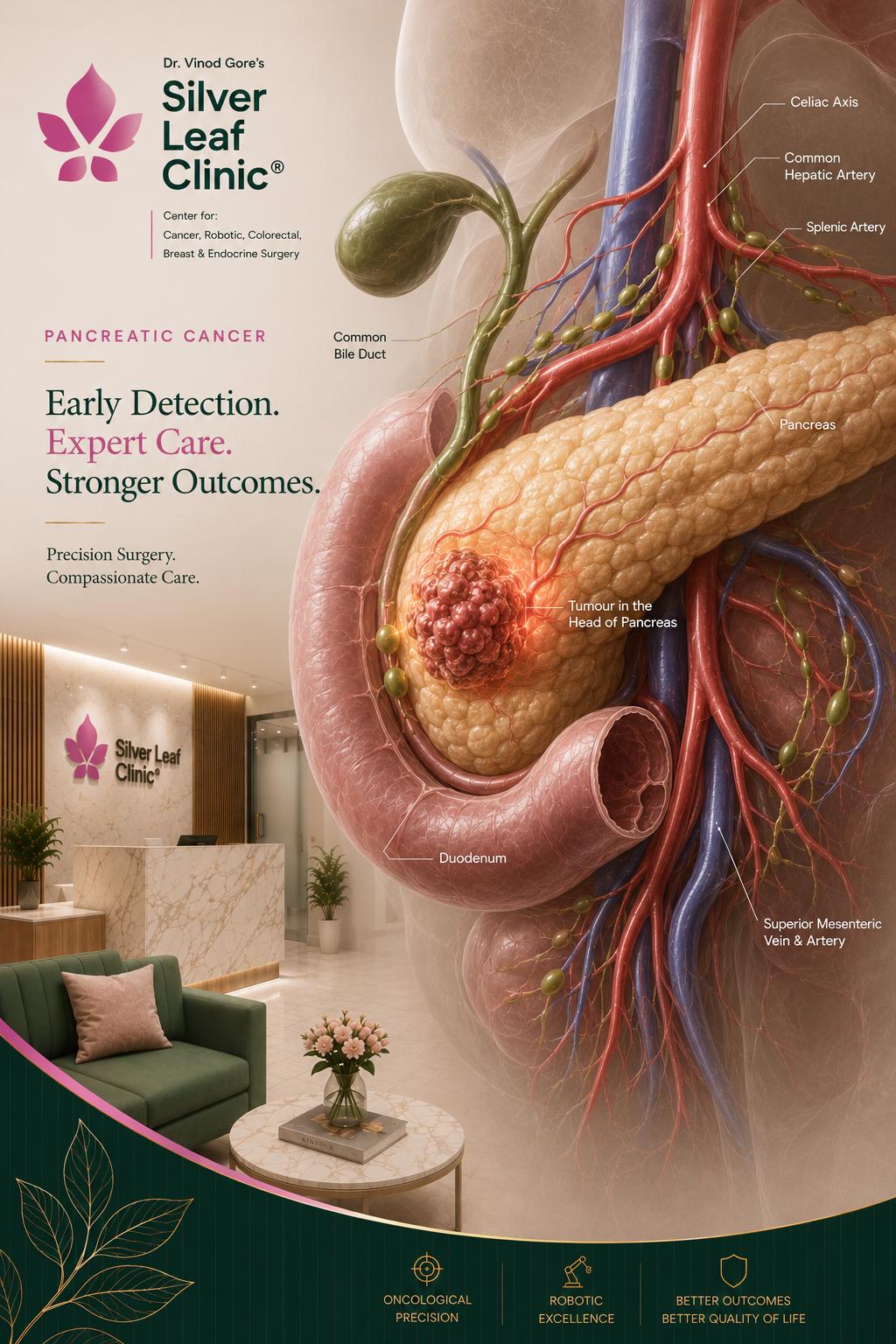
The pancreas is a deep-seated organ behind the stomach that makes digestive juices and the hormone insulin. Most pancreatic cancers are ductal adenocarcinomas, and about two-thirds arise in the head of the pancreas — where they tend to block the bile duct and cause jaundice.
Pancreatic cancer is challenging because it often causes few symptoms until it is advanced, and because the pancreas sits against major blood vessels. Whether an operation is possible depends on the tumour’s relationship to these vessels — what surgeons call resectability.
Surgery offers the only chance of cure, but it is demanding, and outcomes are markedly better in experienced, high-volume hands. Today the best results come from combining surgery with chemotherapy given before and/or after the operation.
Before anything else, the team decides whether the cancer can be removed safely. This depends on how the tumour relates to the major blood vessels nearby, and it shapes the whole plan.
Most pancreatic cancer is sporadic, but several factors raise the risk — the most important being smoking.
Prevention & vigilance: not smoking is the most effective step. People with a strong family history or known genetic syndrome should seek genetic counselling — surveillance can be offered to those at high inherited risk.
Head-of-pancreas tumours often announce themselves with painless jaundice; body and tail tumours tend to cause pain and weight loss and present later.
Diagnosis uses a pancreatic-protocol (triphasic) CT scan, MRI/MRCP, endoscopic ultrasound (EUS) with biopsy, the CA 19-9 blood marker, and sometimes a staging laparoscopy. Outcomes depend heavily on stage and on whether the tumour can be removed — and modern chemotherapy is steadily improving them.
| Stage | Classification | Description | 5-yr Survival* |
|---|---|---|---|
Stage I | T1–T2, N0 | Confined to the pancreas and resectable. Surgery plus chemotherapy offers the best chance of cure. | 30–40% |
Stage II | T3 or N1 | Larger or limited node spread, still often resectable. Surgery with chemotherapy. | 15–25% |
Stage III | Major vessel involvement / N2 | Locally advanced. Chemotherapy ± radiotherapy; some tumours convert to operable. | ~10–15% |
Stage IV | Any T, Any N, M1 | Spread to distant organs. Systemic therapy to control disease and maintain quality of life. | Variable |
*Survival figures are general estimates and are improving with modern multimodality treatment; your individual outlook depends on many factors and is best discussed in person.
Pancreatic cancer is treated as a carefully sequenced plan — chemotherapy and surgery together, in the order that gives the best chance of cure.
The operation removes the part of the pancreas containing the tumour, along with nearby lymph nodes and, when needed, a segment of involved vein. The procedure depends on where the cancer sits — and wherever it is safe, Dr. Gore uses a robotic approach.
The Whipple procedure removes the head of the pancreas together with the duodenum, the gallbladder, the lower bile duct and nearby lymph nodes — then rebuilds the connections so food and bile flow normally again. It is one of the most complex operations in surgery. Performed robotically, the magnified 3D view and wristed instruments allow precise dissection around the major vessels and a careful pancreatic reconstruction — with studies showing less blood loss, fewer wound infections and a shorter hospital stay than open surgery, and equivalent cancer clearance. As with all pancreatic surgery, results are best in experienced, high-volume hands.
The Whipple procedure is one of the most demanding operations in medicine, and its outcomes depend strongly on the experience and volume of the surgeon and centre. A robotic approach, in skilled hands, adds the benefits of less blood loss and faster recovery — without compromising the completeness of the cancer operation.
Modern pancreatic cancer care is built on combining good surgery with chemotherapy — and increasingly on a minimally-invasive, robotic approach to the operation itself.
References: PRODIGE 24/CCTG PA.6 — Conroy T et al., N Engl J Med 2018;379:2395–2406. ESPAC-4 — Neoptolemos JP et al., Lancet 2017. PREOPANC — Versteijne E et al., J Clin Oncol 2020. Robotic PD — pooled RCT/PSM meta-analyses, 2021–2025. This information is educational and does not replace a personal consultation.
Surgery offers the only chance of cure, but it is only possible when the tumour can be removed completely — which depends on its relationship to the major blood vessels (resectability). Some borderline tumours can be made operable with chemotherapy first. An experienced pancreatic surgeon should always assess the scans, as tumours sometimes judged inoperable elsewhere can be removed in expert centres.
The Whipple (pancreaticoduodenectomy) removes the head of the pancreas along with the duodenum, gallbladder and lower bile duct, then reconnects the remaining pancreas, bile duct and stomach to the bowel. It is the main curative operation for cancers of the pancreatic head, and Dr. Gore performs it both robotically and open.
In experienced hands, robotic Whipple offers less blood loss, fewer wound infections and a shorter hospital stay, with the same cancer clearance and margins as open surgery. It is one of the most advanced robotic operations and should only be done by surgeons with specific training and high volume.
Usually both are considered. Chemotherapy before surgery (neoadjuvant) is used for borderline tumours to improve the chance of complete removal. Chemotherapy after surgery (adjuvant), such as modified FOLFIRINOX, significantly improves survival and is a crucial part of treatment.
Most patients return to a good quality of life. You may need pancreatic enzyme capsules with meals to digest food, and blood sugars are monitored (insulin is always needed after total pancreatectomy). A dietitian supports your recovery and nutrition throughout.
Pancreatic surgery is technically complex and carries real risks. Studies consistently show that outcomes — including safety and survival — are significantly better when the operation is done by a high-volume surgeon in a high-volume centre. Experience is one of the most important factors in a good result.
Bring your CT/MRI scans, biopsy report and CA 19-9. Dr. Gore reviews the imaging personally to assess resectability — tumours sometimes judged inoperable elsewhere may still be removable — and explains your robotic surgical options.