Robotic Pelvic Surgery
The pelvis is the hardest place in the abdomen to operate — a deep, narrow bony funnel packed with the rectum, delicate nerves that control continence, bladder and sexual function, and major blood vessels. It is precisely here that the robot transforms what is possible. The da Vinci Xi gives the surgeon a magnified 3-D view and wristed, tremor-free instruments that reach deep into the pelvis where the human hand and straight laparoscopic tools struggle. Dr. Vinod T. Gore, FARIS-trained (Edinburgh), performs the full range of robotic colon and rectal cancer operations with nerve-sparing precision.
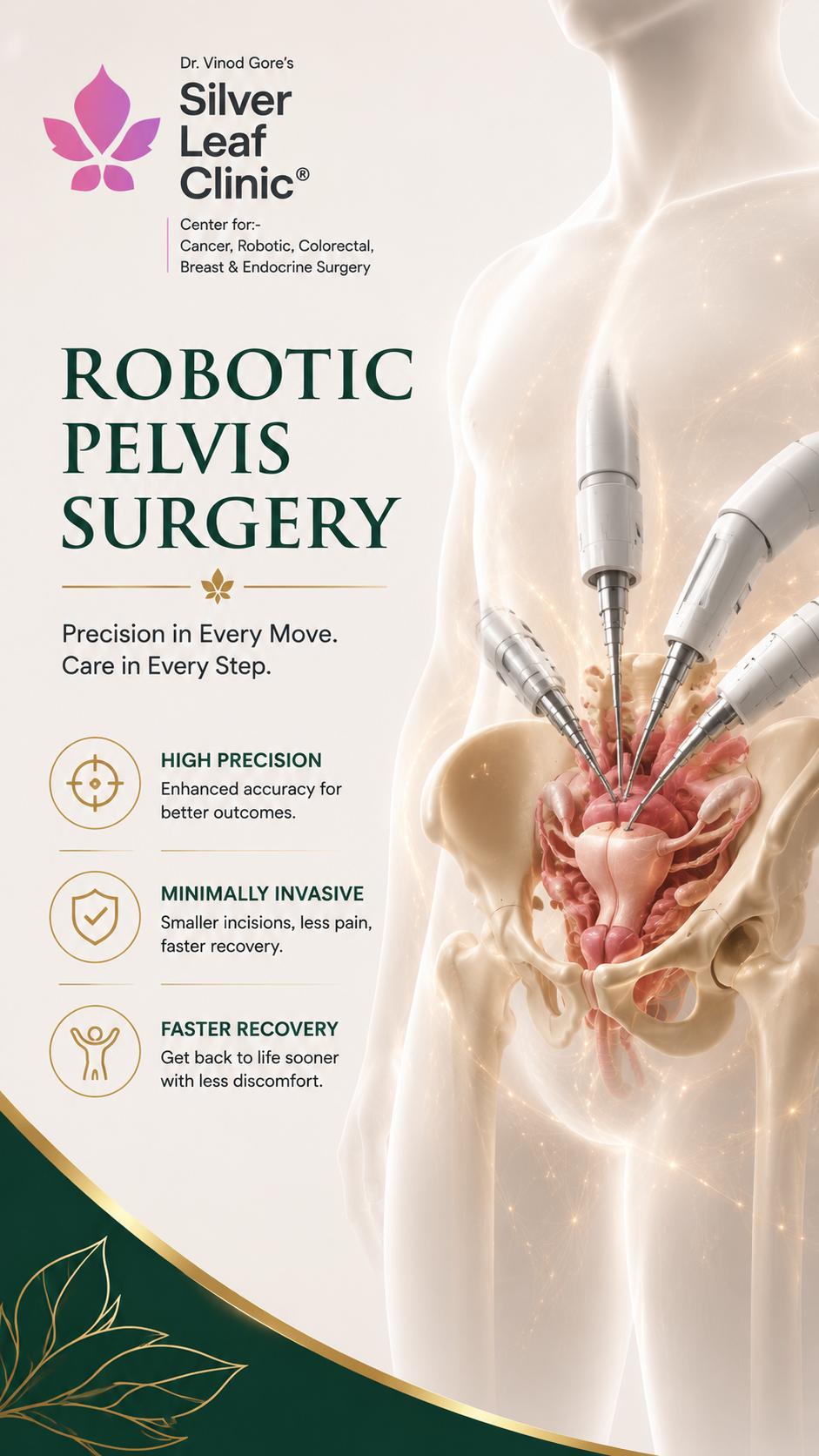
Why the robot is made for pelvic surgery
Operating on rectal cancer means working at the very bottom of a deep, bony funnel that narrows as it goes — especially in men and in a narrow pelvis. Wrapped around the rectum are the autonomic nerves that control the bladder, sexual function and the anal sphincter, and major blood vessels that must not be injured. The cancer operation must remove the rectum and its lymph-node-bearing envelope (the mesorectum) completely and intact, while sparing all of this.
Doing this through a large open incision means operating deep in shadow, by feel as much as sight. Straight laparoscopic instruments cannot angle into the depths of the pelvis. The robot solves both problems at once.
At the console, the surgeon has a brightly lit, ten-times magnified 3-D view right down to the pelvic floor, and instruments that bend and rotate like a wrist to work around corners no straight tool can reach. Tremor is filtered out, so dissection along the precise nerve-sparing planes is steady and exact.
The outcome is a better, cleaner total mesorectal excision (TME), more reliable nerve preservation, and — for the patient — less blood loss, less pain and a faster recovery. For pelvic cancer surgery, this is where robotics makes its single biggest difference.
What the robot delivers
Every advantage of the robotic platform counts double in the confined space of the pelvis.
The full range of robotic colectomy
Whichever part of the colon is affected, the corresponding resection can be performed robotically — with complete mesocolic excision and proper lymph node clearance.

| Operation | For tumours in… | What is done |
|---|---|---|
| Right hemicolectomy | Caecum & ascending colon | Right colon removed with complete mesocolic excision and central (D2/D3) node clearance; intracorporeal join |
| Left hemicolectomy | Descending colon | Left colon removed with its mesocolon and nodes; colon rejoined |
| Transverse colectomy | Transverse colon | Mid-colon segment removed with its lymphatic drainage |
| Sigmoid colectomy | Sigmoid colon | Sigmoid removed with high vascular ligation and node clearance; colorectal join |
| Total proctocolectomy | Whole colon & rectum (e.g. FAP, synchronous tumours) | Entire colon and rectum removed, with reconstruction (pouch) or end stoma as appropriate |
All robotic colectomies aim for complete mesocolic excision (CME) with central node clearance — the colon equivalent of a good TME — for the best oncological result. ICG confirms bowel perfusion before each join.
Rectal cancer — precision where it matters most
Rectal surgery is where robotic precision is most valuable. Every operation below is built on a meticulous, nerve-sparing total mesorectal excision (TME) — the foundation of both cure and good function.
Closely related: Sphincter Preservation, Stoma Care & Reversal, and the Rectal Cancer condition page.
Seeing blood supply & anatomy in real time
The da Vinci Xi has ICG fluorescence built in, and it is especially valuable in colorectal surgery.
Read more on our dedicated ICG Fluorescence page.
What it means for you
A balanced summary for colorectal cancer surgery. The robot is an outstanding tool in suitable cases; the right approach is always chosen for the individual patient and tumour.
| Factor | Robotic (da Vinci Xi) | Open surgery |
|---|---|---|
| Vision in the pelvis | Magnified 3-D, lit to the pelvic floor | Deep, shadowed, harder to see |
| Nerve preservation | Nerves clearly seen & spared | Effective but more difficult deep down |
| Reach into the pelvis | Wristed instruments angle in | Limited by the bony funnel |
| Blood loss | Typically less | More in deep dissection |
| Pain & incisions | Small ports, less pain | Long incision, more pain |
| Hospital & ICU stay | Usually shorter | Often longer |
| Recovery | Faster return to normal | Slower |
| Cancer outcome (TME quality) | Equivalent or better | Proven, equivalent |
For the situations where open surgery is the safer choice — bulky, locally advanced or emergency disease — see our Open Cancer Surgery page. The best approach is always individualised.
Robotic pelvic surgery — answered plainly
This page is general information, not personal medical advice. Whether robotic surgery is right for you depends on your tumour and overall health, decided at a multidisciplinary tumour board. Please bring all scans and reports to your consultation.
Ask about robotic colorectal surgery
If you or a family member has colon or rectal cancer, Dr. Gore can advise whether robotic pelvic surgery is the best approach — and whether the sphincter can be preserved. Please bring all CT/MRI/PET scans, colonoscopy and biopsy reports, and any previous operative notes — ideally on CD or shared via WhatsApp in advance.